

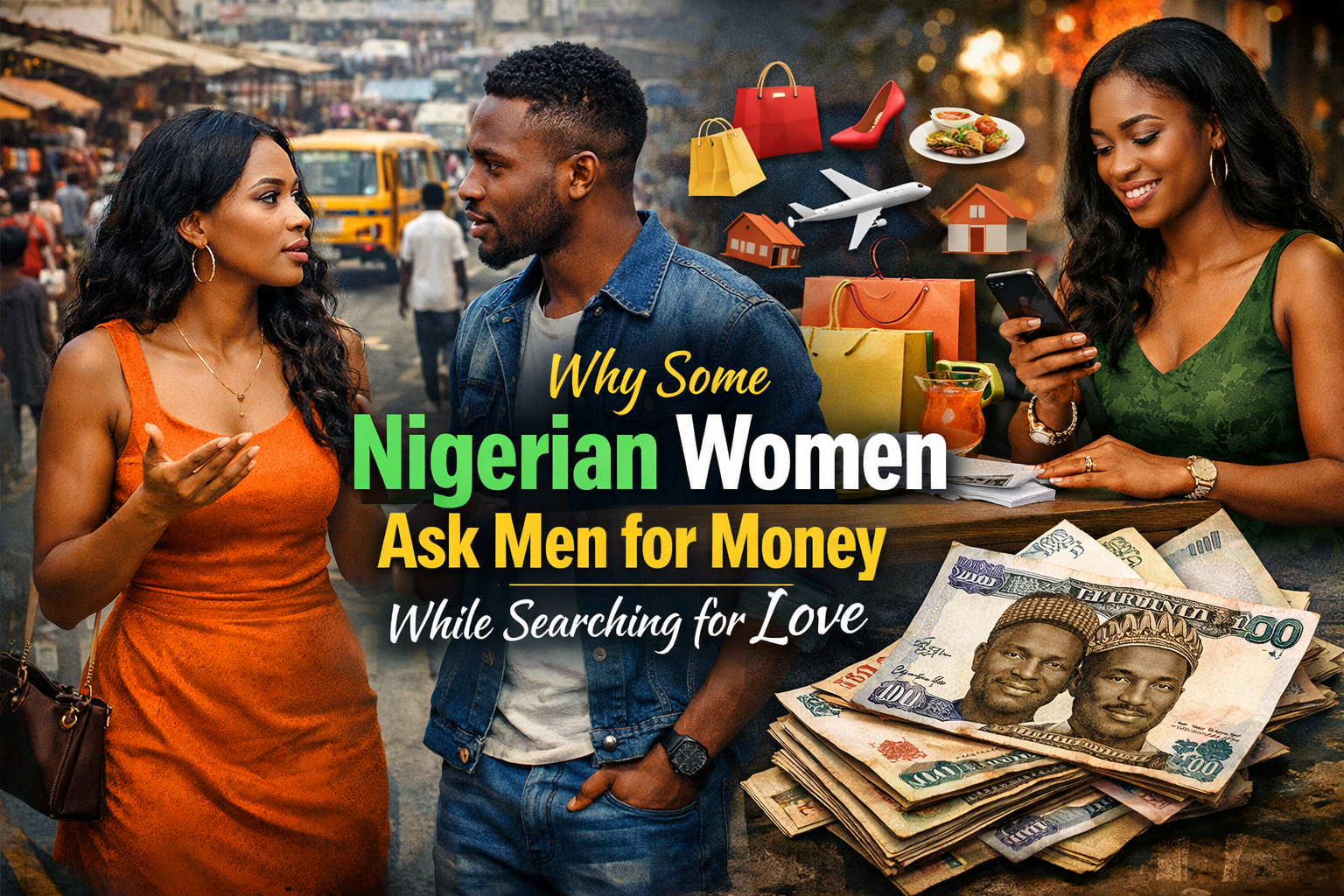
Nigeria is a country known for its warmth, beauty, and deep emotional connections. But in recent years, a recurring debate has taken over social media timelines, podcasts, and everyday conversations: Why do some Nigerian women ask men for money while dating, even when they say they are looking for love?
The answer, many say, lies at the intersection of culture, economics, and modern relationship expectations.
Love in an Economy Under Pressure
Romance in Nigeria does not exist in a vacuum. Rising living costs, unemployment, and financial uncertainty shape how people approach relationships. For many women, dating is not only about emotions—it is also about stability.
In an environment where survival can be difficult, financial support is often viewed as part of emotional security. Asking for money is sometimes less about luxury and more about coping with daily realities.
Cultural Beliefs About Provision
Traditionally, Nigerian society places the role of provision on men. A man who gives is often seen as serious, responsible, and ready for commitment. As a result, money becomes a measuring tool—not necessarily of wealth, but of intention.
For some women, financial gestures answer a critical question early on: Is this person capable of taking responsibility?
Dating in an Age of Distrust
Many women point to emotional disappointments as the reason they guard their hearts closely. Promises without action have made some cautious. In response, financial commitment becomes a form of proof—an early sign that a man’s words align with his actions.
However, critics argue that this approach risks turning relationships into transactions, pushing away men who value emotional connection over financial display.
Social Media and Lifestyle Pressure
The rise of social media has intensified expectations. Online, relationships are often measured by what is given—trips, gifts, rent payments, business support. Over time, this shapes real-life behavior, creating pressure to equate love with spending.
What is rarely shown, however, is whether those relationships are emotionally healthy or lasting.
Survival or Strategy?
Experts and commentators often distinguish between need and manipulation. Some women genuinely require help and hope love will grow alongside support. Others adopt financial requests as a strategy, believing that if a man cannot give, he is not worth emotional investment.
Both realities exist—and both continue to fuel debate.
“Not All Nigerian Women”
Amid the controversy, one fact remains clear: not all Nigerian women ask men for money. Many are financially independent, career-driven, and uncomfortable mixing money with romance. They seek partnership, not sponsorship.
Generalizing the behavior risks unfairly labeling millions of women whose values and experiences differ.
The Bigger Issue: Expectations vs. Connection
At the heart of the debate is a mismatch of expectations. Men often feel pressured and reduced to financial providers. Women often feel insecure and unsupported without tangible proof of care.
When money enters too early, love can feel conditional. When it stays out completely, insecurity can grow. Finding balance remains the challenge.
Why This Conversation Matters
This debate reflects a larger truth about modern relationships in Nigeria: love is negotiating space with economic reality. Until financial pressure eases and emotional trust improve, money will likely continue to play an outsized role in dating.
For now, one thing is certain—the conversation is not going away. And as Nigerians continue to redefine love in changing times, the line between affection and financial expectation remains one of the most contested spaces in modern dating.
Keywords: Nigeria dating culture, Nigerian women and money, relationships in Nigeria, love and finances, social trends Nigeria