


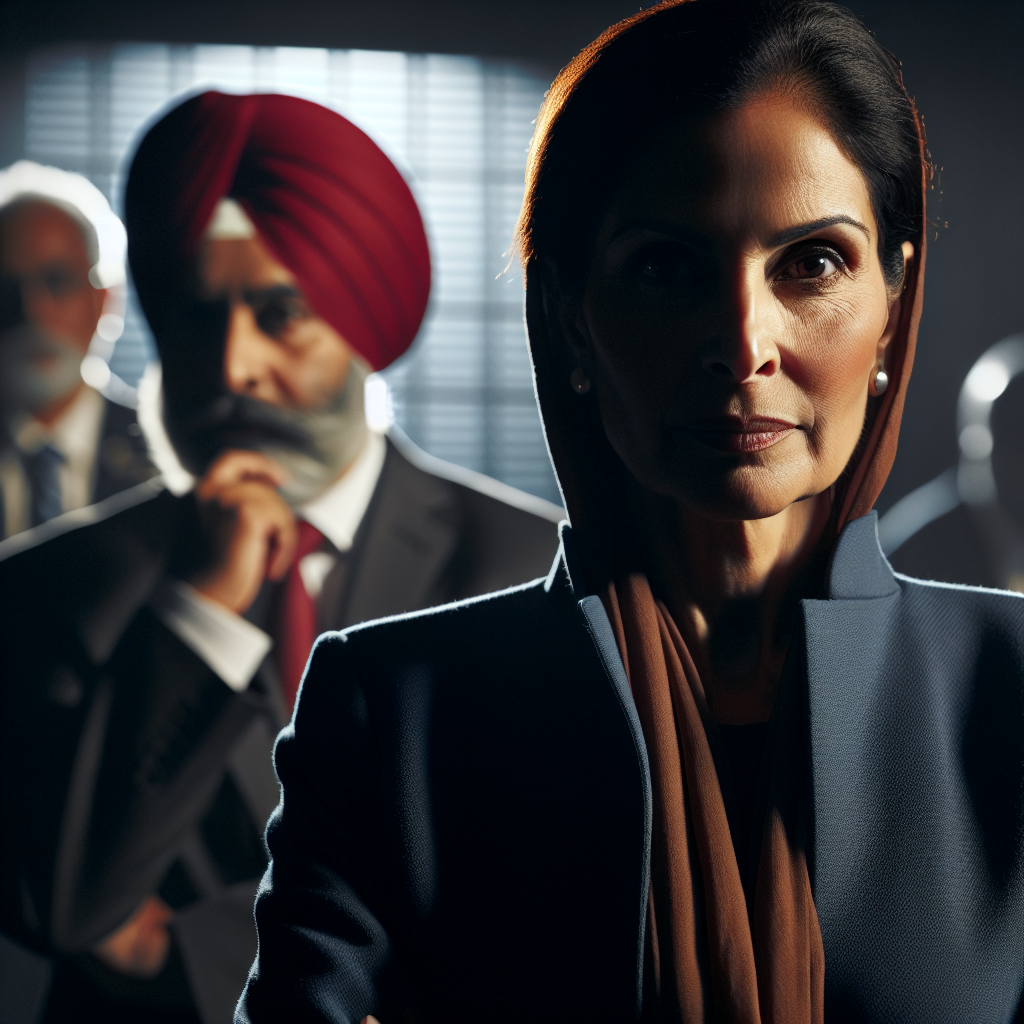
Punjab’s political class is once again reading between the lines when it comes to Navjot Singh Sidhu and Navjot Kaur Sidhu. While Kaur has stepped back into the political arena with visible aggression and renewed public engagement, her husband has continued to project formal distance from active frontline politics. Even so, his recent appearances, symbolic interventions and carefully worded public messaging have ensured that speculation around his next move refuses to die down.
The contrast has created a familiar Sidhu-style puzzle for Punjab. On one side is Kaur, politically assertive and seemingly ready to reoccupy space in a state where personal networks, visibility and timing often matter as much as party structures. On the other is Navjot Sidhu, former Punjab Congress chief, who is not openly reclaiming the political stage but is also not behaving like a man entirely removed from it. That ambiguity is what has set off renewed debate inside Congress circles and beyond.
A family long tied to Punjab’s public life
The Sidhus are not newcomers to political theatre in Punjab. Navjot Singh Sidhu first built his public identity as a cricketer and television personality before making the jump to electoral politics. Over the years, he became one of the most recognizable faces in Punjab politics, known as much for his rhetorical flair as for his capacity to unsettle allies and opponents alike. His journey across party lines and his rise within the Congress made him a central, if often unpredictable, figure in the state’s power struggles.
Navjot Kaur Sidhu, too, has had her own political trajectory and public standing. Her return to an aggressive political posture matters because Punjab’s politics often runs on layered signals: public meetings, social media interventions, organizational activity and strategic appearances all feed wider narratives about factional strength. In that sense, her activism is not being viewed in isolation. It is being read as part of a larger political message, whether coordinated or not.
Why Congress is watching closely
For the Congress in Punjab, any movement associated with Sidhu carries significance. The party has struggled in recent years with internal factionalism, leadership uncertainty and the challenge of rebuilding its social coalition after losing ground in the state. Sidhu remains a figure with name recognition, a support base and the ability to dominate headlines. That makes him politically relevant even when he is not holding formal office or leading an active campaign.
At the same time, that relevance cuts both ways. Within Congress, Sidhu has long represented both energy and instability. He can mobilize attention, but he can also complicate leadership equations. This is why his current posture is generating so much interest: a leader who stays partially outside the ring can still influence who feels secure inside it. Kaur’s assertiveness only sharpens that uncertainty.
Mixed signals and what they mean
In politics, ambiguity is often a strategy in itself. By keeping Punjab guessing, Sidhu retains leverage. He can remain above day-to-day organizational battles while preserving the possibility of a more direct role later. Kaur’s aggressive re-entry, meanwhile, keeps the family’s political relevance alive in public view. Together, the two tracks create a dual message: one openly active, the other deliberately unresolved.
This matters locally because Punjab is in a period of political churn. The state’s voters are sensitive to questions of leadership, credibility and issue-based politics, whether the concerns are agriculture, jobs, governance, corruption or the direction of opposition politics. Any sign that a recognizable political figure may be preparing for a comeback can alter calculations across parties, especially in a state where personality-driven politics remains powerful.
Why the story matters beyond the Sidhu household
The larger significance of this moment lies in what it reveals about Indian regional politics. Parties increasingly rely on leaders who can command public attention beyond formal posts, and politics is often shaped by perception as much as declared strategy. The Sidhu-Kaur dynamic is a textbook example of that phenomenon. It shows how political relevance can be maintained through selective visibility, controlled unpredictability and family-based signaling.
For readers, the story is not simply about whether Navjot Sidhu returns fully to active politics. It is about the state of opposition politics in Punjab, the Congress party’s unresolved leadership questions and the continuing importance of individual charisma in an era of fractured voter loyalties. If Kaur continues her aggressive push and Sidhu continues to send mixed signals, Punjab may be headed toward another round of political suspense in which silence itself becomes a campaign language.