

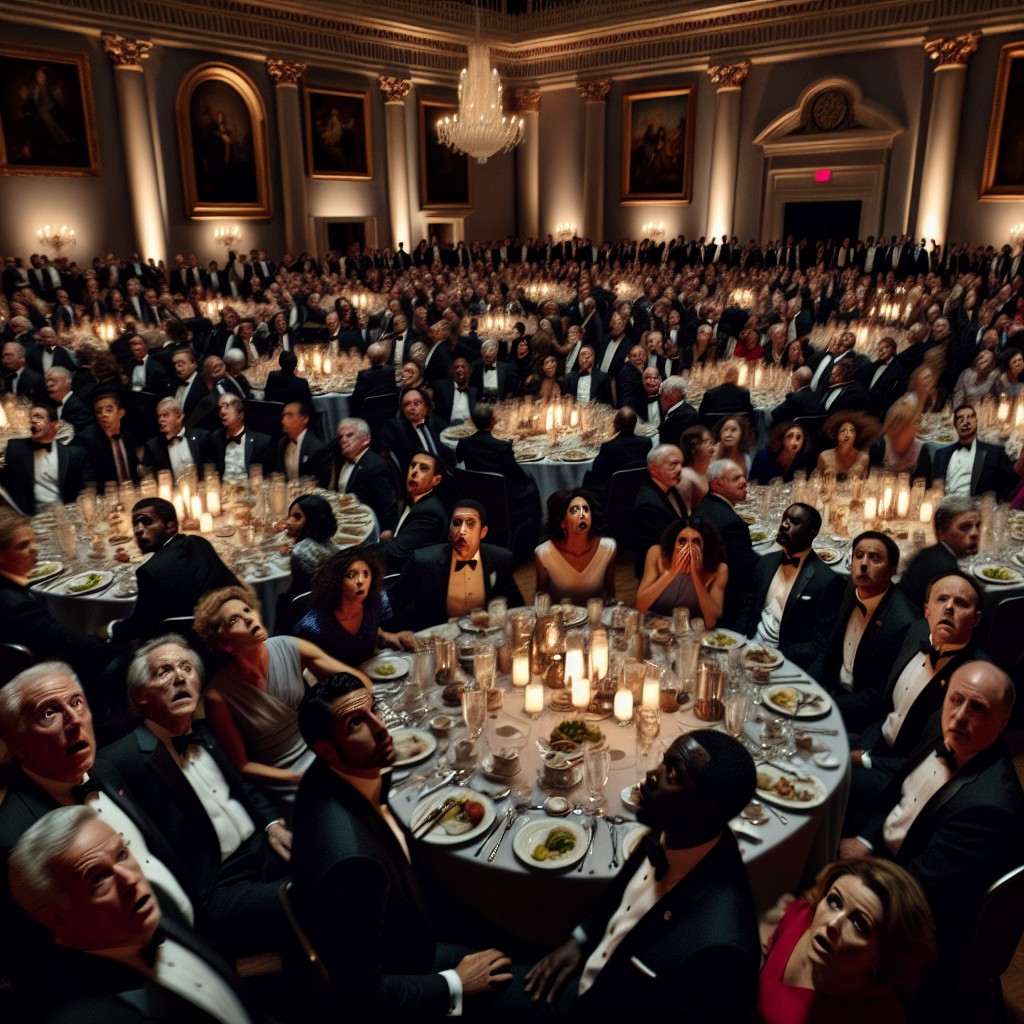
An evening built around ritual, satire and high-profile networking at the 2026 White House Correspondents’ Association dinner took a chaotic turn when mysterious thuds interrupted the event, followed by what attendees described as an eerie silence and then confusion inside one of Washington’s most closely watched annual gatherings. According to the source material, the first signs that something was wrong came around 8:35 p.m. Saturday, when audible but unexplained noises broke through the dinner atmosphere during the event attended by President Donald Trump, journalists, public officials and invited guests.
The White House Correspondents’ Association dinner, often referred to simply as the WHCD, occupies a unique place in American political culture. It is at once a social event, a fundraiser, a display of press access and a symbolic annual meeting point between the presidency and the journalists who cover it. That unusual mix has long made it a stage for both levity and tension. Under normal circumstances, the dinner is remembered for speeches, jokes and celebrity appearances. When something goes wrong, however, it immediately becomes more than a society-page incident. It raises questions about security, the fragility of public events and the increasingly charged atmosphere surrounding politics and media in the United States.
A Washington Tradition With a Fraught History
The correspondents’ dinner has been part of the capital’s institutional calendar for decades, though its meaning has shifted over time. Presidents have often used the occasion to project ease under pressure, trading jokes with the very reporters scrutinizing their administrations. At the same time, critics have long argued that the event can appear too cozy, blurring the line between a free press and the people in power. In recent years, that tension has only grown sharper as distrust of media institutions and political polarization have intensified.
Trump’s relationship with the press has been especially contentious, making any appearance connected to White House journalists inherently more politically charged than in many past administrations. That broader context helps explain why a disruption at such a dinner would draw immediate national attention. It is not merely about a social gathering being interrupted; it is about disruption at an event that symbolizes the uneasy relationship between government and the media.
Why the Incident Resonated Beyond the Ballroom
In Washington, a disturbance at a presidential event instantly triggers overlapping concerns: personal safety, institutional security and political symbolism. Even before official explanations emerge, moments like this tend to expose the level of anxiety that now surrounds major public appearances. In an era shaped by heightened threat awareness, unusual sounds in a room filled with top journalists, political figures and Secret Service protection do not remain minor curiosities for long. They become potential national stories within minutes.
The implications are both local and broader. Locally, any disruption at a major Washington event can prompt review of hotel security, access procedures and emergency response protocols for future gatherings involving senior officials and large media contingents. More broadly, the incident underscores how public life in democratic capitals now unfolds under constant security pressure. The United States is hardly alone in this. Around the world, political events that once emphasized ceremonial openness are increasingly shaped by concerns over disruption, threats and crowd safety.
Why This Story Matters
For readers, the significance of this episode lies in what it reveals about the current state of American civic life. The correspondents’ dinner is supposed to represent a moment, however stylized, when democratic institutions can share the same room: political leaders, watchdog journalists and the public image of openness. Chaos intruding into that setting is unsettling because it punctures the idea that even the most choreographed events are fully under control.
It also matters because moments of uncertainty at prominent public gatherings now travel instantly through social media, television and digital news, often before verified information is available. That dynamic can amplify public fear and political speculation. Responsible coverage therefore becomes essential: reporting what is known, acknowledging what is not and placing events in context rather than exaggerating them.
As more details emerge, the 2026 White House Correspondents’ Association dinner may be remembered either as a brief but alarming interruption or as a more consequential security episode. Either way, the scene described in the source material — unexplained thuds, a sudden hush, then disorder — captured a truth larger than one evening in Washington: in today’s political climate, even long-standing democratic rituals can feel one moment away from instability.