
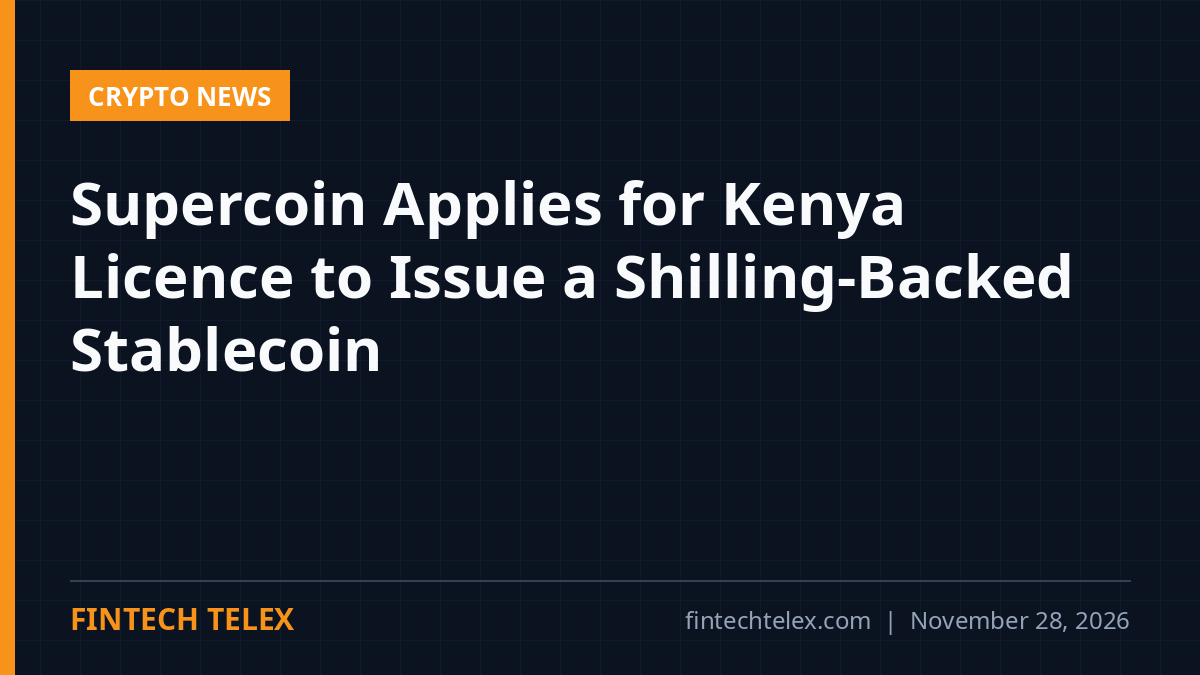
NAIROBI — A South African stablecoin issuer wants to bring a Kenyan shilling token to market next year, in a bid to move money between Africa’s two most active crypto economies without routing it through the US dollar.
Supercoin, the digital payments company owned by Betway parent Super Group, said it has applied to the Central Bank of Kenya (CBK) for a stablecoin issuance licence and plans to start serving payment companies in the first half of 2027, subject to approval, TechCabal reported.
How the rand-to-shilling rail would work
Supercoin already issues ZARsc, a rand-backed token it launched in South Africa in September 2025. The proposed Kenyan token, KESsc, would be pegged one-to-one to the shilling, with reserves held in a Kenyan bank, according to The Sharp Daily, citing industry reporting.
Under the plan, a remittance firm would take in rand in South Africa, swap ZARsc for KESsc and pay out in Kenya. Today, most such transfers involve buying dollars and then selling them again.
“If we can provide enough liquidity to the ZAR-KES pair in our stablecoin, then we can start selling that rail for instant payments between South Africa and Kenya,” Supercoin managing director Gideon Greaves told TechCabal.
Greaves said the company would start with remittance firms, fintechs and payment networks, with a Kenyan consumer wallet expected in the second half of 2027. “The wallet is very much a secondary business for us,” he said. “Our core focus … is the issuance side.”
The hard part: cashing out
Moving a token takes seconds. Getting shillings into an M-PESA wallet or bank account is harder. Greaves said Supercoin had signed an off-ramp agreement with a partner in Kenya, but talks on access to mobile money payouts were still exploratory, TechCabal reported. Safaricom says M-PESA had 42.3 million monthly active customers in Kenya at the end of September.
Supercoin will also face competition. Dollar tokens dominate: the International Monetary Fund estimates stablecoins made up US$3 billion to US$4 billion of the roughly KES 740 billion (US$5.7 billion) Kenyans transacted in crypto in 2025, with Tether’s USDT a common choice. PesaLink, Kenya’s instant payment network, has also partnered with the Pan-African Payment and Settlement System (PAPSS) for local-currency cross-border transfers.
Supercoin says ZARsc has passed 10 million tokens in circulation since launch.
What it means for African users
Local-currency stablecoins are a test of whether crypto rails can cut the “double conversion” cost that hits intra-African payments. If KESsc is approved and liquidity is deep enough, a Kenyan worker in Johannesburg could, in theory, send money home with one currency swap instead of two.
The caveats are real. The CBK has not said whether it will approve the licence. A thin market between the two tokens would mean poor rates, and expensive payouts could erase the savings. Users should only deal with licensed providers and confirm how reserves are held and audited.
Fintech Telex will report the CBK’s decision when it is made.
This article is for information only and is not investment advice.