


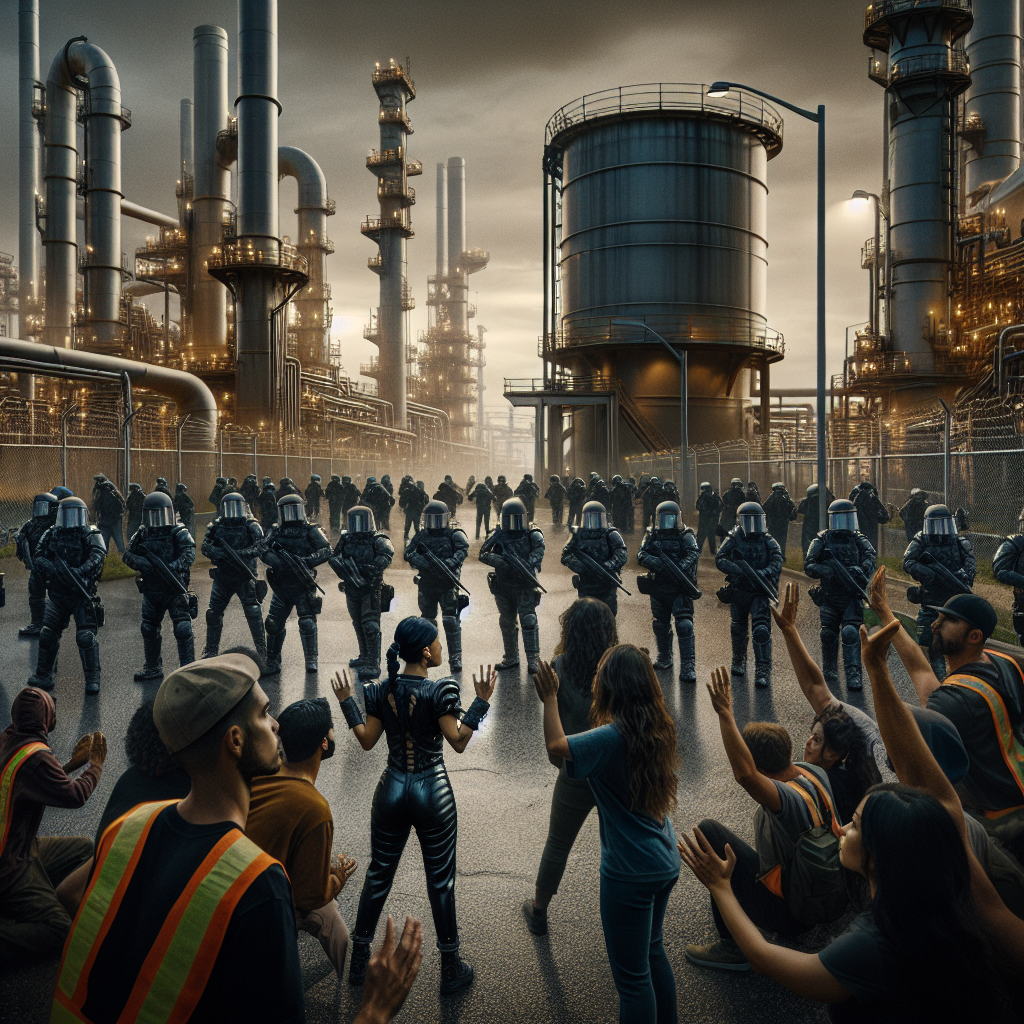
Irish police moved to clear protesters blockading the country’s only oil refinery on Saturday, escalating a standoff that underscored growing public anger over high fuel prices and the wider pressure on households and businesses from energy costs. The action came after a senior government minister said the demonstrations had created a “very dangerous economic movement,” reflecting official concern that disruption at such a critical energy site could quickly ripple across the economy.
The protest focused national attention on the Whitegate refinery in County Cork, a strategically important facility in Ireland’s energy system. Because Ireland has only one oil refinery, any sustained interference with operations or access raises immediate concerns about fuel supply, distribution, and price stability. Even short-term blockades can unsettle markets, alarm transport operators, and heighten anxiety among consumers already dealing with elevated living costs.
Why the Refinery Matters
The Whitegate site plays an outsized role in Ireland’s fuel infrastructure. As the state’s only refinery, it is central to processing and supplying petroleum products used across transport, industry, agriculture, and home heating. In a country that remains significantly dependent on imported energy, the smooth functioning of this facility is closely linked to national economic resilience.
That helps explain the government’s hardening tone. While protests over fuel prices tap into widespread frustration, authorities also have to weigh public order and the risk of supply disruptions. A blockade at an ordinary commercial site is one thing; a blockade at a major energy installation carries broader implications for essential services, business continuity, and public confidence.
Fuel Prices and a Wider Cost-of-Living Strain
The unrest in Ireland mirrors pressure seen across Europe and beyond whenever oil and gas prices surge. Fuel costs have a direct impact on motorists, but they also feed into the price of goods, food, public transport, and logistics. For rural communities, where driving is often unavoidable, price spikes can be especially painful. Small businesses, hauliers, farmers, and tradespeople tend to feel the effects quickly because fuel is a core operating expense.
Public frustration over fuel prices often emerges during broader cost-of-living squeezes, when families are already facing higher bills in other areas. In that environment, protests can gather momentum fast, especially if people believe governments are not moving quickly enough to ease the burden. The political challenge for any administration is balancing short-term relief with longer-term energy policy, taxation, and environmental commitments.
A Familiar Pattern in European Energy Politics
Disputes over fuel prices have repeatedly triggered protests across Europe. In several countries, anger over transport costs or fuel taxes has evolved into wider debates about inequality, regional disadvantage, and the affordability of climate transition policies. Ireland’s latest refinery protest fits into that broader pattern: energy prices are rarely just about the pump. They become a proxy for deeper concerns about wages, inflation, infrastructure, and whether the costs of economic change are being shared fairly.
Ireland’s geographic position also adds to the stakes. As an island nation, it depends heavily on secure fuel imports and efficient domestic distribution. That makes any disruption at a key node of the supply chain more sensitive than it might be in larger countries with multiple refineries or more extensive alternatives.
Why This Story Matters
For readers, this story matters because it sits at the intersection of daily life and national policy. Fuel prices influence commuting costs, delivery charges, food prices, and the viability of many local businesses. A protest at a major refinery is therefore not only a law-and-order issue; it is also a signal of how economic stress can spill into public unrest.
It also raises a longer-term question about energy security. Governments across Europe have been reminded in recent years that dependence on volatile global energy markets can have swift domestic consequences. Events like the blockade in Ireland highlight how fragile supply chains can become when geopolitical pressures, market swings, and public discontent converge.
As police act to restore access, the immediate priority will be preventing further disruption. But the underlying anger that brought protesters to the refinery gates is unlikely to disappear quickly. That leaves the Irish government facing a familiar but difficult task: containing the immediate crisis while addressing the broader affordability concerns that made it possible in the first place.