

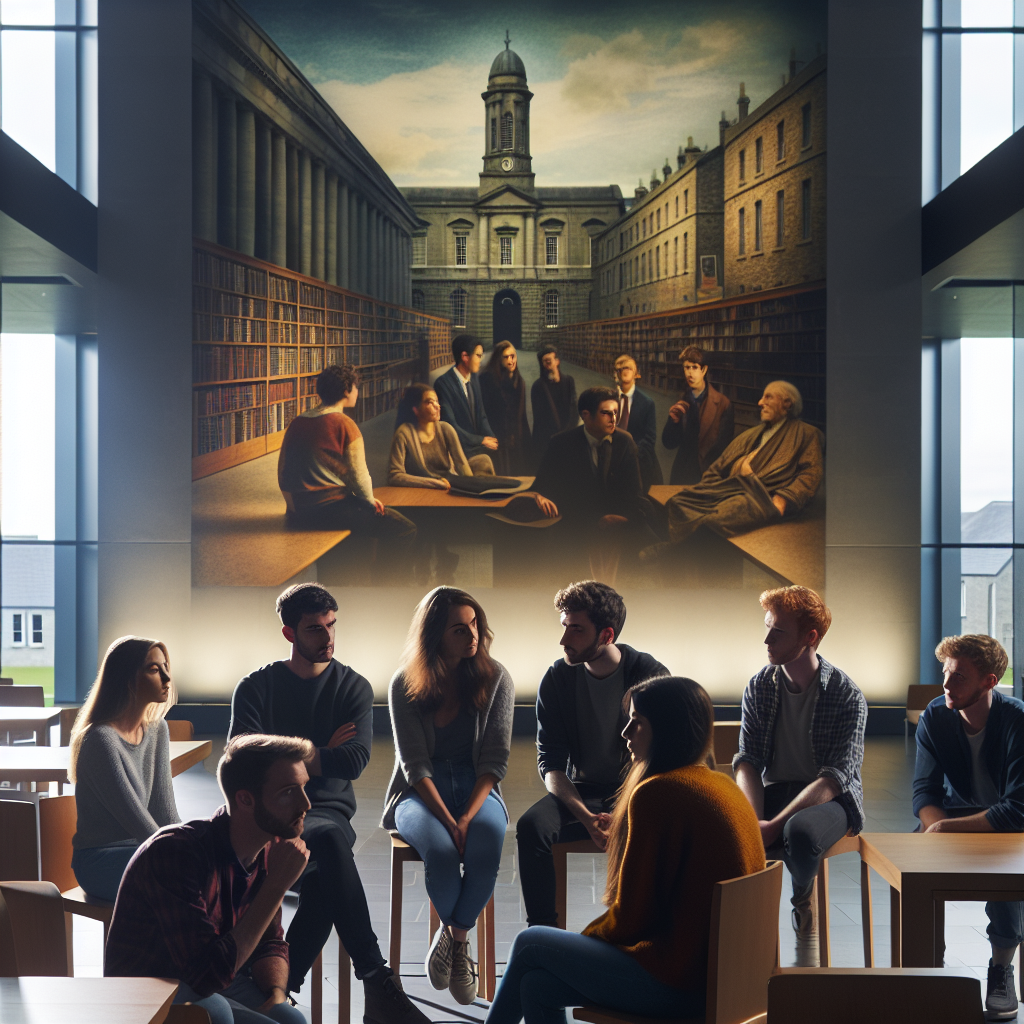
As discussion about Irish unity continues to move from the political margins into mainstream debate, a group of University College Dublin students are offering a note of caution: before any constitutional change is seriously contemplated, people on both sides of the border may need to better understand one another. Their reflections, drawn from everyday life rather than party platforms, suggest that identity, memory and culture remain more complicated than slogans about a united Ireland can capture.
At the centre of the conversation is Madison Twamley, a third-year UCD politics student from Newtownards, Co Down, an area with a strongly unionist tradition. Her experience of celebrating St Patrick’s Day in Dublin with classmates became a revealing moment about how Northern identity can be perceived in the Republic. The incident highlighted a broader point made by students: that assumptions about what it means to be British, Irish, Northern, unionist or nationalist still shape interactions in ways that can be awkward, emotional and politically significant.
The gap between political debate and lived experience
The constitutional future of Northern Ireland has become a recurring subject in recent years, driven by Brexit, demographic change and renewed discussion of the Good Friday Agreement’s provision for a potential border poll. Yet students speaking about the issue appear less interested in dramatic predictions than in the social realities that any such change would bring. Their message is that legal unification and social integration are not the same thing.
That distinction matters. Northern Ireland was created in 1921 after the partition of Ireland, and for decades competing national loyalties shaped politics, education, housing and public life. The Troubles, a conflict that lasted roughly from the late 1960s until the 1998 Good Friday Agreement, left deep scars across communities. Although the peace process transformed daily life and sharply reduced violence, it did not erase inherited identities or the mistrust built over generations.
For younger people, those divisions are often encountered indirectly, through family memory, school systems, community traditions and symbols. That can create a disconnect between how the past is discussed in theory and how it is felt in practice. Students’ concerns that there is sometimes a romanticised view of the Troubles reflect anxiety that people who did not live through the violence may reduce it to a political narrative while overlooking its human cost.
Why student perspectives matter
Student opinion may not determine constitutional outcomes, but it offers a useful window into a generation that will live with the consequences of whatever comes next. Universities are among the few places where young adults from different backgrounds regularly meet, test assumptions and encounter unfamiliar views. When those students say there is still much to learn across the border, that suggests the emotional groundwork for any future settlement remains unfinished.
This matters beyond campus. If support for Irish unity grows, the practical questions would be immense: healthcare, education, taxation, policing, citizenship, public symbols and political representation would all come under scrutiny. But beneath those policy debates lies a more sensitive challenge: whether unionists, nationalists and those who identify as neither could feel secure and respected in a changed constitutional arrangement.
The issue also has implications for Britain, the European Union and the United States, all of which have long had an interest in preserving stability in Northern Ireland. Any serious movement toward unification would not be a purely symbolic event; it would reshape relationships within these islands and draw international attention because of the peace process’s global significance.
A reminder that identity is personal, not abstract
What makes the students’ reflections especially resonant is that they move the unity debate away from campaign rhetoric and toward personal experience. For many in the Republic, Northern Ireland can still feel politically familiar but socially distant. For many in the North, particularly from unionist backgrounds, crossing into southern spaces can bring a heightened awareness of being misunderstood or stereotyped. That mutual unfamiliarity may be one of the least dramatic but most important obstacles to any shared future.
In that sense, the story is not only about whether Irish unity may happen one day. It is about whether people across the island are prepared to have the harder conversation first: not just what constitutional arrangement they prefer, but how they imagine living together. The students’ warning is simple, but significant. Before maps are redrawn in anyone’s mind, relationships may need to be rebuilt.