


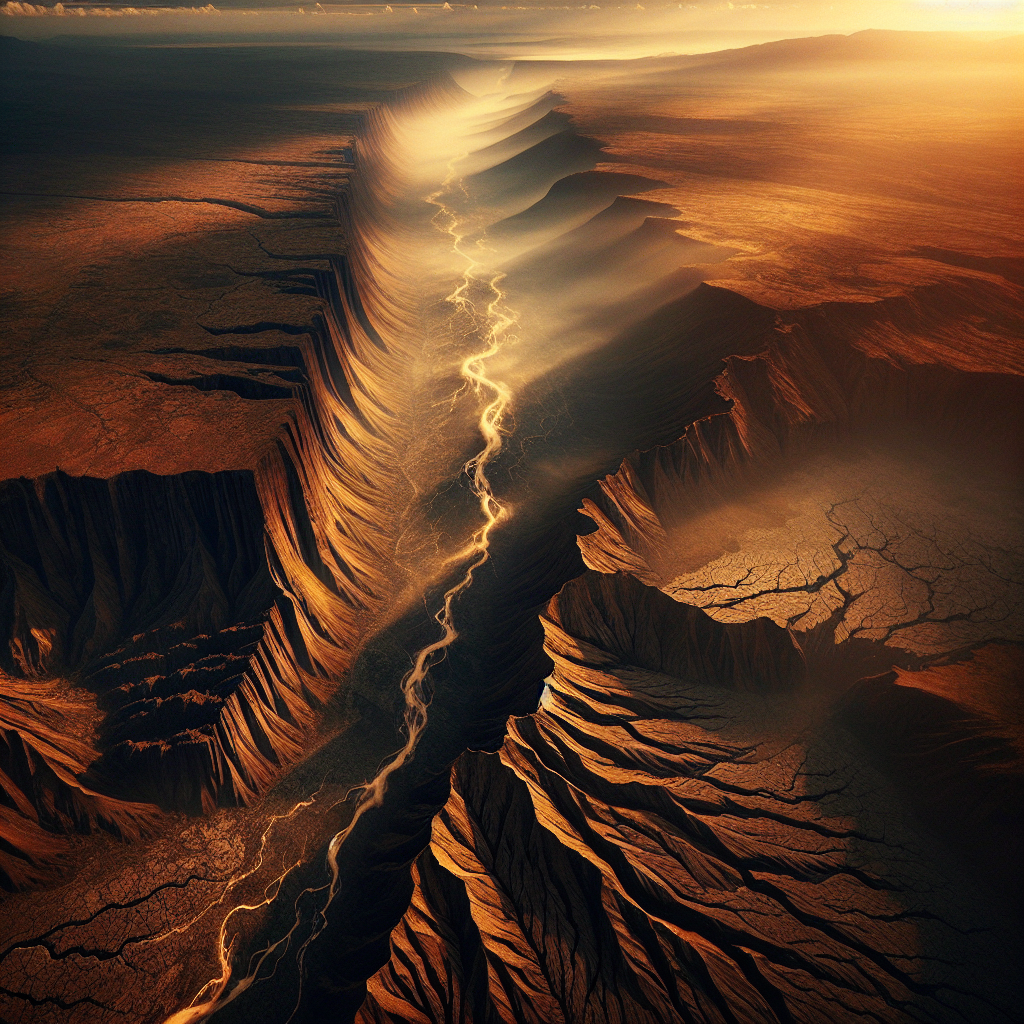
The idea of a continent splitting apart sounds like the premise of a disaster movie. In reality, the slow breakup unfolding in East Africa is less an approaching apocalypse than one of the most important natural laboratories on Earth. Deep beneath the surface, tectonic forces are pulling parts of the African continent in different directions along a network of rifts that meet in the Afar region of Ethiopia. Over vast stretches of geological time, that process could eventually create a new ocean basin.
For scientists, that makes East Africa extraordinary. The changes are far too slow to threaten humanity on the timescale of daily life, but they are happening in a place where researchers can observe the mechanics of continental breakup more clearly than almost anywhere else on the planet. The result is a rare chance to study how continents deform, how oceans begin, and how life adapts in extreme environments shaped by fire, heat and shifting ground.
A continent in motion
Africa sits atop a major tectonic plate that is gradually being stretched and divided. In eastern Africa, that strain is expressed through the East African Rift System, a vast zone of faulting and volcanic activity that runs through multiple countries. In the Afar region, the process becomes especially significant because three tectonic rifts converge there, forming what geologists call a triple junction. It is one of the few places on Earth where the early stages of continental breakup can be studied on land.
The basic story begins deep inside the Earth, where heat from the mantle helps weaken the crust above. As the crust thins, fractures open, volcanoes erupt and sections of land gradually sink. Given enough time, seawater can eventually flood the low-lying basin, creating a new ocean. That sequence has happened before in Earth’s history. Many geologists see East Africa as offering a glimpse of processes that once shaped places such as the Atlantic Ocean, which began as a rift before widening into a vast marine basin.
Why Afar fascinates scientists
The Afar Depression is often described as one of the harshest environments on the planet. It is intensely hot, geologically active and difficult to work in. Yet those very conditions make it invaluable for research. Because the crust there is unusually thin and volcanic activity is frequent, scientists can gather clues about the interaction between tectonic plates, magma and surface landscapes in near real time, at least by geological standards.
Researchers use seismic monitoring, satellite measurements and field surveys to track how the land is moving and cracking. Volcanic episodes and earthquake swarms can reveal how molten rock forces its way through the crust, sometimes opening fissures that mimic the earliest stages of seafloor spreading. These observations help scientists test long-standing theories about how continents rupture and how new oceanic crust forms.
The region also interests biologists and climate scientists. Extreme settings shaped by volcanic gases, salt flats and hydrothermal systems can offer insight into how organisms survive under severe stress. Such environments are sometimes used as analogues for conditions that may resemble early Earth or even other planetary worlds.
What it means for people living there
Although the creation of a new ocean lies millions of years in the future, the rift has real consequences in the present. Earthquakes, volcanic hazards and ground deformation can affect communities, infrastructure and water systems across parts of East Africa. Better understanding the geology is therefore not just an academic exercise. It can improve hazard assessment, guide land-use planning and help governments prepare for natural risks in fast-growing regions.
The rift system also shapes agriculture, lakes, mineral resources and geothermal energy potential. In some places, tectonic activity creates opportunities as well as danger, particularly where geothermal heat can be harnessed for electricity. That gives the science a practical dimension for countries seeking reliable energy and resilience in the face of environmental change.
Why this story matters
Stories like this capture attention because they remind us that Earth is not fixed. Continents, oceans and mountains are all temporary features in a planet that is constantly remaking itself. The East African rift offers a powerful, visible example of that truth. It is a lesson in deep time, but also in immediacy: the same forces that will one day reshape a map are already influencing landscapes and lives today.
For readers, the excitement lies in the scale of the revelation. Scientists are not merely observing cracks in the ground; they are watching one chapter of Earth’s long history unfold. In Afar, a forbidding region is becoming one of the clearest windows into how the planet works. That makes Africa’s great geological divide not a tale of destruction, but a story of discovery.