


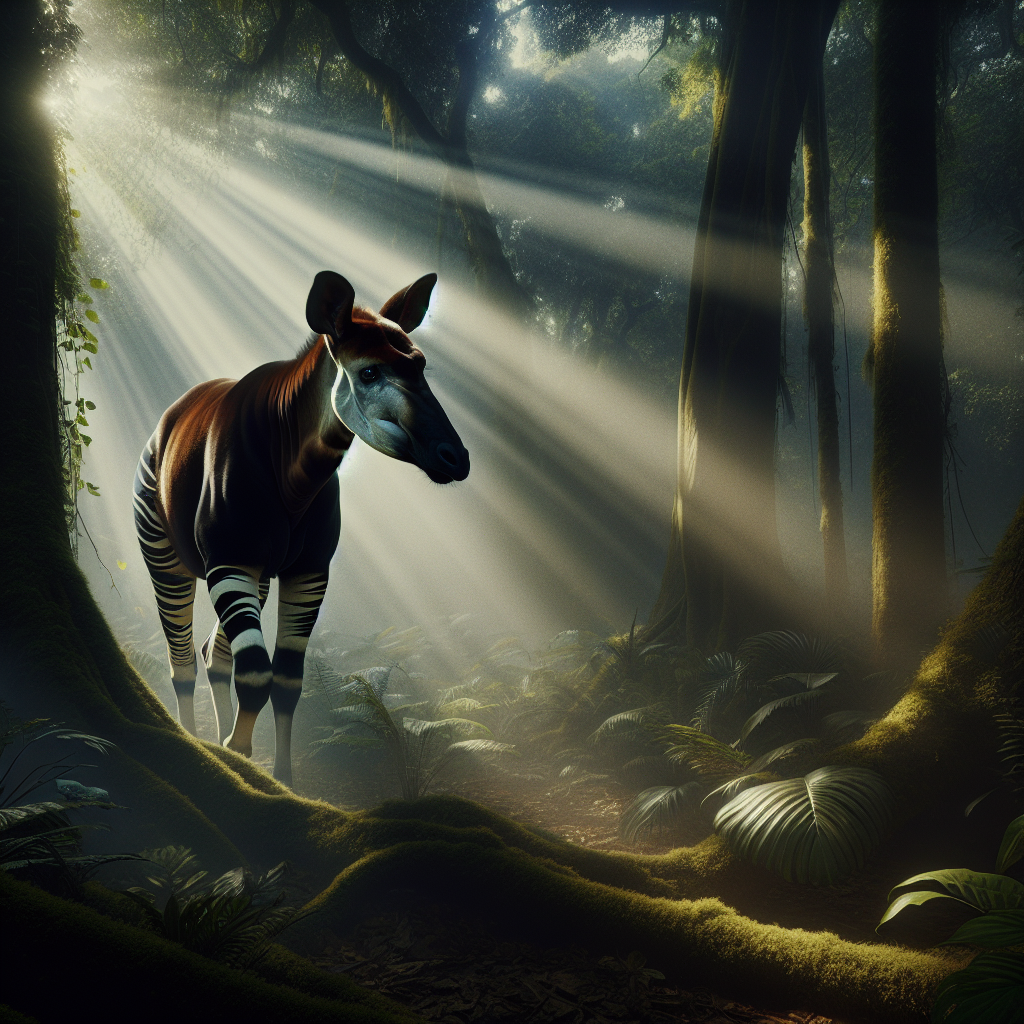
The okapi has long been one of Africa’s most intriguing animals, a creature so unusual in appearance that it can seem almost imaginary at first sight. With its velvety brown body, zebra-like stripes across its hindquarters and legs, and an elongated face that recalls its closest living relative, the giraffe, the okapi stands apart from nearly every other mammal in the rainforest. Native to the dense forests of the Democratic Republic of Congo, it is both visually striking and remarkably difficult to spot, which has helped give it an almost mythical reputation.
Although people sometimes describe the okapi as a cross between a zebra and a giraffe, that comparison is only superficial. The stripes are a distinctive feature, but scientifically the okapi is much more closely linked to the giraffe than to the zebra. Its build is compact, adapted for moving quietly through thick vegetation rather than striding across open savannah. This mix of familiar and unfamiliar traits is part of what has fascinated scientists, conservationists and wildlife enthusiasts for generations.
A rare animal with a remarkable history
The okapi remained unknown to much of the outside world until the early twentieth century, even though it had long been known to local communities in Central Africa. When Western scientists first documented it, the animal quickly drew global attention because it seemed to challenge easy classification. Its discovery was a reminder that the world’s rainforests still held large mammals that had escaped broad scientific recognition, and that Indigenous knowledge often precedes formal study.
Over time, the okapi became one of the most recognizable symbols of the Congo rainforest. Yet its secrecy is not merely part of its charm; it is also central to its survival. Okapis tend to live alone, rely on camouflage, and move through forest habitats where human visibility is limited. These traits make them hard to study in the wild, which is one reason the species continues to be described as mysterious even today.
Why the okapi matters beyond its unusual looks
The renewed interest in the okapi is about more than a curious animal with dramatic markings. It also shines a light on the health of one of the planet’s most important forest ecosystems. As a native species of the Congo rainforest, the okapi serves as an indicator of broader environmental conditions. When attention turns to the okapi, it often leads to wider discussion about habitat loss, forest degradation, illegal hunting and the pressures placed on biodiversity in Central Africa.
That gives the story global significance. Rainforests in Africa play a critical role in storing carbon, regulating local climates and supporting a vast range of plants and animals. Protecting species such as the okapi is closely tied to protecting those larger ecological systems. In that sense, fascination with the animal can have practical value: the more the public understands and cares about iconic but vulnerable wildlife, the stronger the case for conservation can become.
An animal that captures public imagination
There is also a cultural reason the okapi continues to attract attention. In an age when many people feel they already know the world’s major wildlife species, the okapi remains a genuine surprise. It reminds readers that nature still resists simplification. Not every animal fits neatly into popular categories, and not every important species is widely recognized. That sense of discovery is part of why stories about the okapi resonate so strongly.
For readers, the okapi offers a compelling entry point into bigger questions about science, conservation and how knowledge is formed. It shows that animals can be both familiar and little understood, and that biodiversity is often richest in places facing the greatest pressure. The okapi’s unusual appearance may be what first grabs attention, but its real importance lies in what it represents: the extraordinary complexity of rainforest life and the urgency of preserving it.
In the end, the okapi is not simply a biological curiosity. It is a living symbol of a fragile ecosystem, a reminder of how much remains hidden in the natural world, and a call to look more closely at the species that depend on forests for survival. Its mystery is part of its appeal, but its future will depend on whether that fascination can be turned into lasting protection.