


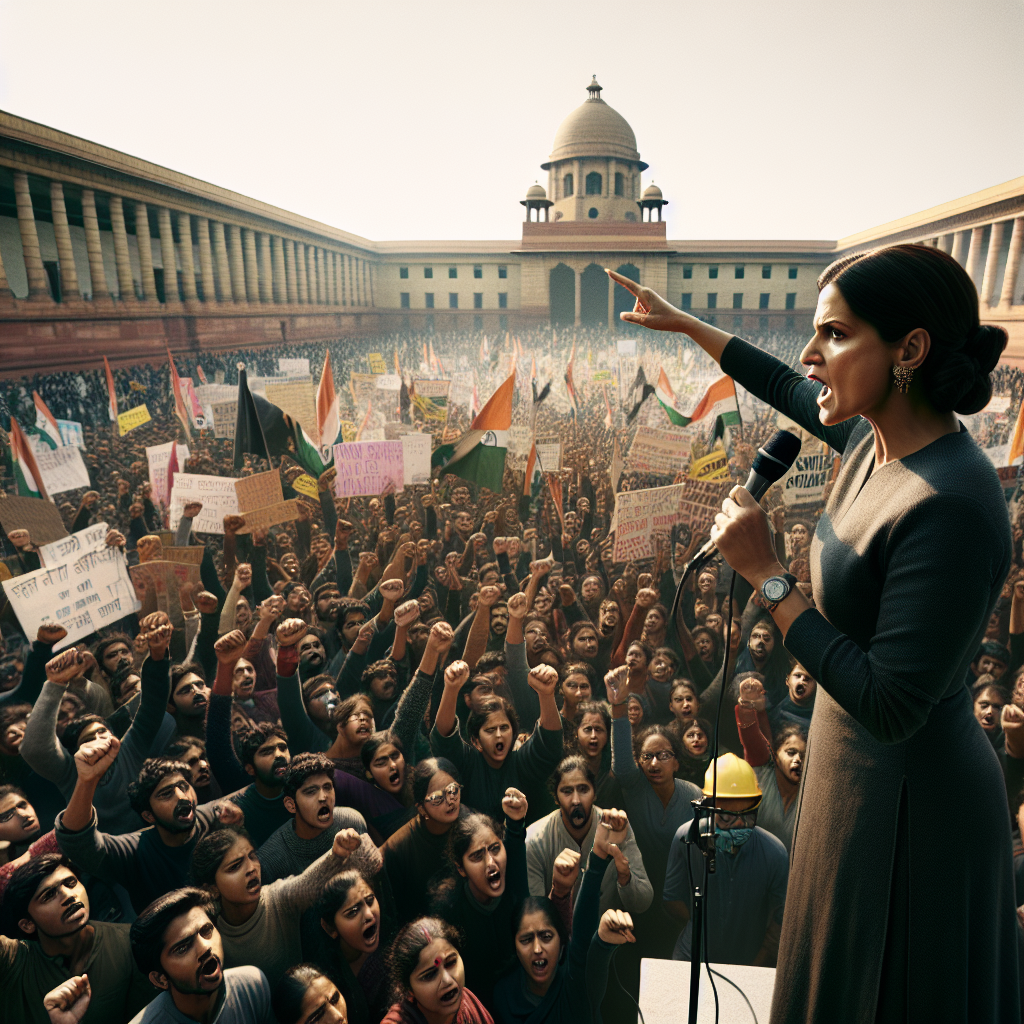
Delhi’s political temperature rose sharply on Tuesday as AAP MLA and Leader of the Opposition Atishi staged a protest outside the Delhi Assembly alongside other party members, accusing the BJP of misleading the public and presenting what the opposition described as a “fake budget.” The confrontation added a fresh layer of tension to an already combative political environment in the national capital, where governance disputes often spill beyond legislative debate into public protest.
The immediate trigger for the clash was the budget discussion, with the Aam Aadmi Party alleging that the ruling side had failed to address core civic and infrastructure concerns. AAP also linked its criticism to the recent Palam fire incident, arguing that such events expose deeper weaknesses in urban planning, emergency preparedness and service delivery. At the same time, the Delhi chief minister presented what was described as a “green budget,” placing sustainable development at the center of the government’s policy messaging.
A familiar pattern in Delhi politics
The latest standoff fits into a long-running pattern in Delhi, where political conflict often centers on who is truly responsible for the city’s daily governance. As the national capital, Delhi has a uniquely layered administrative structure. Power is shared and contested among the elected government, the Lieutenant Governor, the municipal system and the Union government. That arrangement has, for years, produced recurring friction over budgets, policing, civic management, infrastructure and welfare delivery.
AAP, which built much of its political identity around education, health, subsidized utilities and local service delivery, has frequently accused its rivals of obstructing governance or failing to prioritize ordinary residents. The BJP, for its part, has often challenged AAP’s claims, questioned its financial management and positioned itself as the more credible force on administration and development. In that sense, the current exchange is not an isolated controversy but part of a broader struggle over political narrative ahead of future electoral contests.
Why the budget dispute matters
Budgets are more than accounting documents in Indian politics. They signal priorities, shape public expectations and provide parties with a platform to argue that they alone understand the needs of citizens. When the opposition calls a budget misleading, it is really making a larger claim: that the government’s promises do not match conditions on the ground. When the government presents a green budget, it is likewise making a larger argument that sustainability, cleaner growth and long-term planning are now central to modern urban governance.
For residents, the questions are practical. Will spending improve roads, drainage, fire safety, water supply and public transport? Will environmental commitments translate into cleaner air, better waste management and more resilient neighborhoods? Delhi’s voters are often less interested in abstract ideological contests than in whether the state can function smoothly in a city burdened by congestion, pollution, uneven infrastructure and dense population pressure.
Infrastructure, safety and public trust
The reference to the Palam fire incident gives the dispute added weight because it shifts the argument from political rhetoric to public safety. In fast-growing urban areas, fire incidents and infrastructure failures tend to reignite difficult questions about building compliance, emergency access, overcrowding and the readiness of civic agencies. Opposition parties often seize on such events to argue that governance failures have human consequences, while governments respond by emphasizing reforms, spending commitments and future planning.
This is where public trust becomes crucial. Citizens expect not only announcements but visible implementation. A budget framed around sustainability can carry significance if it supports stronger urban resilience, safer public spaces and better emergency systems. But if political confrontation overwhelms policy follow-through, even well-branded initiatives risk being dismissed as symbolic.
The larger implications
What happens in Delhi often carries influence beyond the city. As India’s capital, its policy debates receive national attention and can shape conversations in other states about urban governance, environmental priorities and accountability. A serious push toward green spending in Delhi could become a model for other major cities facing climate pressure, pollution and infrastructure stress. Equally, persistent political deadlock can serve as a warning about how institutional conflict hinders effective administration.
For readers, this story matters because it sits at the intersection of politics and everyday life. The clash between AAP and BJP is not only about legislative spectacle; it is about who can claim credibility on the issues that most directly affect urban residents. Whether the focus is budget transparency, public safety or sustainable development, the outcome of this battle will shape how Delhi is governed—and how its citizens judge those in power.