

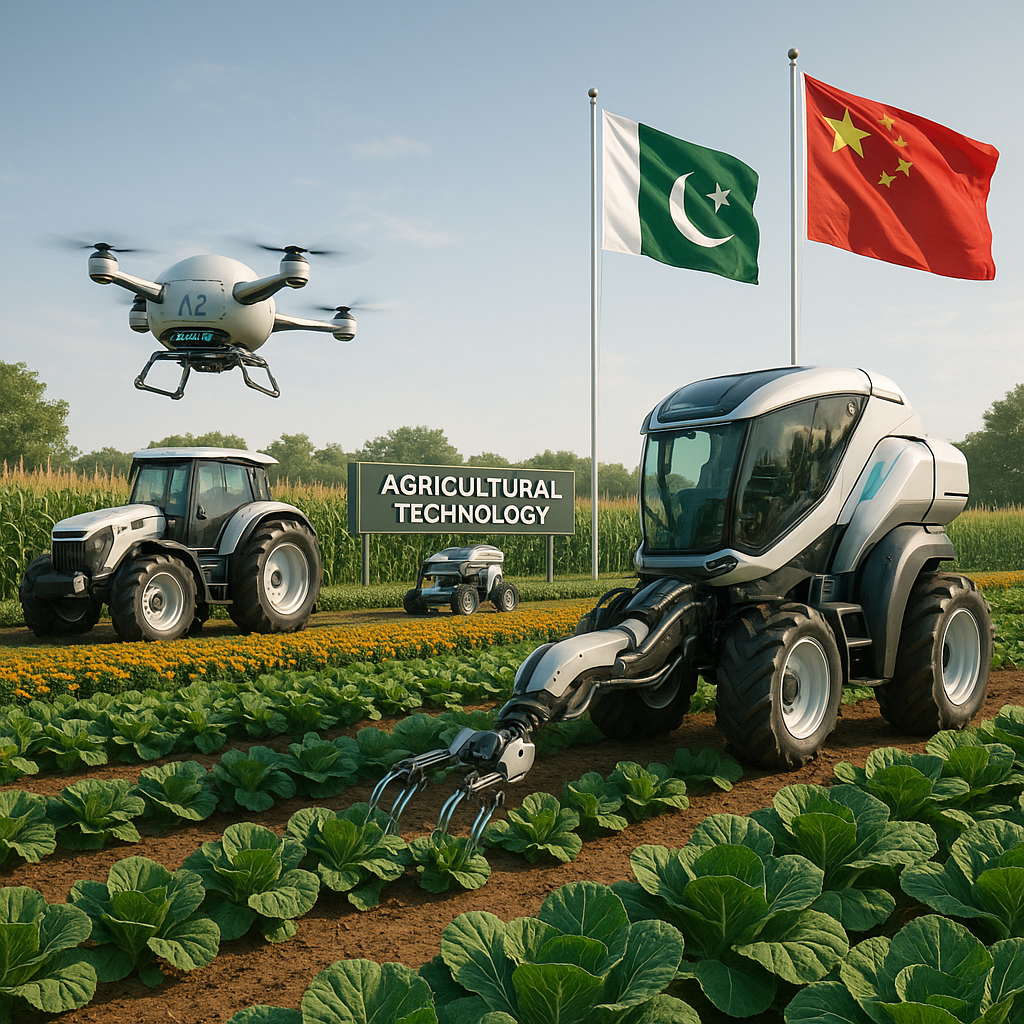
Pakistan has taken another step toward agricultural modernisation with the signing of a letter of intent between the Pakistan Agricultural Research Council (PARC) and China’s FAMSUN Group for the establishment of a FAMSUN Technology Display Park at PARC. The initiative, announced in Islamabad, is being seen as a potentially important platform for introducing advanced agricultural and feed-related technologies to a country where farming remains central to livelihoods, food security and industrial growth.
Although the source announcement provides limited operational detail, the planned display park signals more than a routine institutional partnership. In practical terms, such a facility can serve as a demonstration and knowledge-sharing hub where farmers, researchers, agribusinesses and policymakers observe modern systems in action before considering wider adoption. For Pakistan, where the gap between research, extension services and field-level application has long slowed productivity gains, that model carries obvious appeal.
A push to modernise a foundational sector
Agriculture has historically occupied a defining place in Pakistan’s economy. It supports a large rural population, supplies raw material to major industries and underpins national food systems. Yet the sector has also struggled with recurring structural constraints, including low productivity, uneven mechanisation, post-harvest losses, water stress and limited uptake of advanced processing technologies. Research institutions such as PARC have been tasked with improving agricultural outcomes, but translating scientific progress into widespread commercial practice remains a continuing challenge.
That is why partnerships that connect research bodies with global technology firms often attract close attention. FAMSUN, known internationally for agricultural engineering, feed technology and processing solutions, brings the image of an industrial partner with practical expertise in integrated systems. If implemented effectively, a display park under its banner could expose local stakeholders to modern equipment, digital processes, feed production methods and post-harvest handling systems that are increasingly shaping competitive agricultural economies.
Why the proposed display park matters
The significance of the planned facility lies not only in technology transfer, but also in demonstration. In many developing agricultural markets, adoption does not accelerate simply because a technology exists; it grows when users can see how that technology performs under local conditions. A display park can reduce uncertainty for investors and producers alike. It may also help universities, extension workers and agribusiness firms build stronger links with applied research.
For readers beyond the research community, the broader relevance is straightforward: improvements in agriculture ripple outward. Better feed systems can influence livestock productivity. Better processing and storage can reduce waste. More efficient machinery and scientific management can improve farm incomes and strengthen supply chains. In a country where inflation, food affordability and rural economic resilience are constant public concerns, any serious effort to modernise agriculture has consequences far beyond the farm gate.
Pakistan-China cooperation in a familiar frame
The move also fits into a wider pattern of Pakistan-China economic and technical cooperation. Over the years, collaboration between the two countries has expanded from infrastructure and energy into industrial capacity, research exchange and agriculture. As climate pressures and food security concerns intensify across Asia, agriculture is increasingly emerging as a strategic area for cross-border partnerships. Pakistan’s need for modern inputs and systems, combined with China’s experience in scaling agri-industrial technologies, creates a basis for deeper collaboration.
At the same time, the long-term value of such projects usually depends on local adaptation. Imported machinery or systems do not automatically deliver results unless they are matched with training, maintenance, financing and local agronomic realities. The success of the proposed park will therefore likely depend on whether it becomes a living ecosystem for skills development and problem-solving, rather than simply a symbolic installation.
What comes next
Because the agreement announced is a letter of intent, attention will now turn to implementation. Stakeholders will be watching for signs of how quickly the project moves from paper to physical development, what technologies are prioritised, and how accessible the facility will be to farmers, researchers and private-sector actors. If managed well, the display park could become a visible node in Pakistan’s broader effort to make agriculture more productive, efficient and commercially competitive.
In that sense, the development matters not just as a bilateral agreement, but as a test of Pakistan’s wider ability to convert strategic partnerships into practical gains. At a time when food systems are under pressure from climate change, population growth and market volatility, even seemingly technical projects can carry national significance. The planned FAMSUN Technology Display Park at PARC may therefore prove to be an early indicator of how seriously Pakistan intends to pursue the next phase of agricultural transformation.