
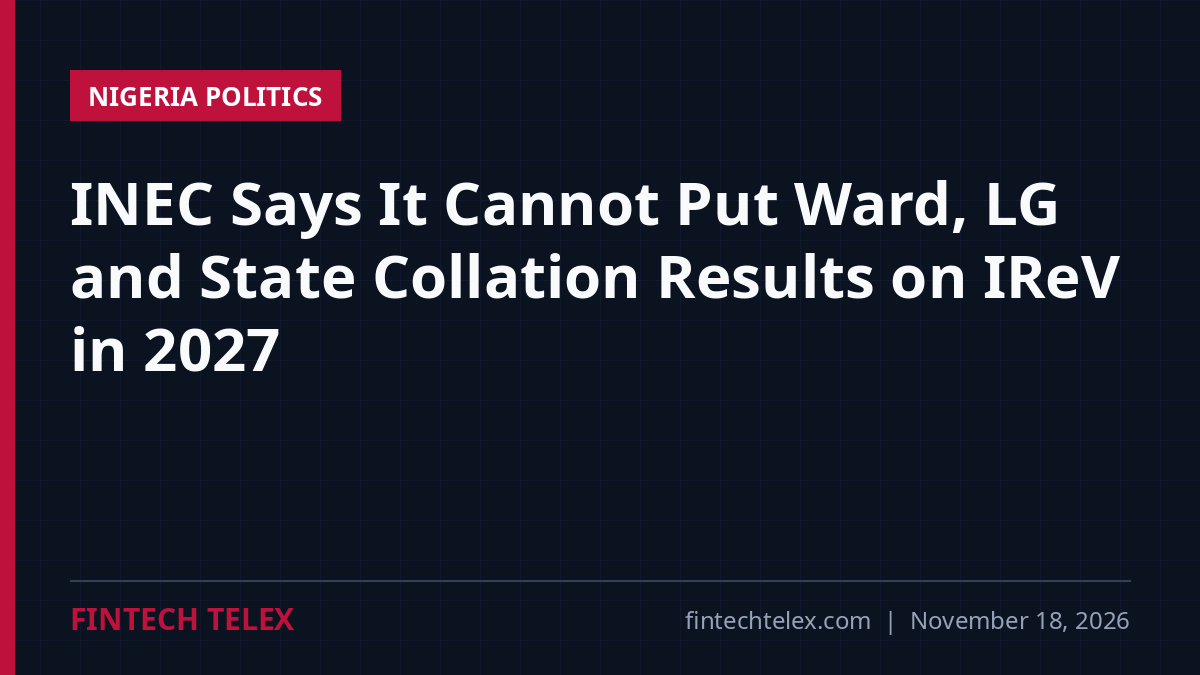
ABUJA — The Independent National Electoral Commission (INEC) says it will not publish results from ward, local government or state collation centres on its Result Viewing Portal (IReV) during the 2027 general elections.
INEC’s Director of Information and Communication Technology, Lawrence Bayode, said the required system had not been developed or tested. “We have not built the system; we have not tested the system,” he said on Tuesday at a roundtable on results tabulation organised by Yiaga Africa in Abuja, Premium Times reported.
What will and will not be online
INEC currently uploads only Form EC8A, the polling unit result sheet, to IReV. Bayode was answering a participant who asked why Forms EC8B, EC8C and EC8D — the ward, local government and state collation results — could not also be uploaded.
Without those forms online, the public cannot use IReV to follow results as they move up through each level of collation. Anyone checking a total must gather polling unit sheets and add them up themselves, Pluboard noted.
The case for wider publication
Yiaga Africa Executive Director Samson Itodo said his organisation had previously recommended that INEC publish the extra forms to improve transparency, Premium Times reported. Other participants said access would help observers spot where discrepancies arise between polling unit figures and collated totals.
Yiaga made similar points in July, when it also urged INEC to explain its backend validation process, The Guardian reported.
INEC’s position
INEC says its safeguards focus on the polling unit. Bayode pledged that the metadata of results uploaded to IReV in 2027 — such as upload time, device and location — would be preserved. “I can assure you those metadata will remain intact,” he said, according to Pluboard.
INEC Chairman Prof. Joash Amupitan said last week that the commission’s post-2023 audit found the worst failures happened at collation centres. He said new validation checks would stop inaccurate or over-voted results from reaching IReV at all, National Accord reported. INEC will hold a nationwide mock accreditation and voting exercise on November 28.
Separately, INEC has rejected claims that BVAS devices can be logged out remotely or that results uploaded offline could be lost, PM News reported.
The Senate Leader, Opeyemi Bamidele, has also said that while IReV improves transparency, it is not a collation platform, Pluboard reported.
The legal backdrop
After the 2023 elections, courts held that IReV is a public viewing portal, not a legal collation system. The Electoral Act 2026 provides for electronic transmission of polling unit results to IReV. However, it says Form EC8A will be the primary basis for collation if transmission fails.
Why it matters
The presidential and National Assembly elections are on January 16, 2027, with governorship polls on February 6. Parties, observers and voters will now rely on polling unit uploads and agents at collation centres to check totals. Watch for whether the November 28 mock exercise changes either side’s position, and whether INEC publishes any timeline for adding collation forms in future elections.