

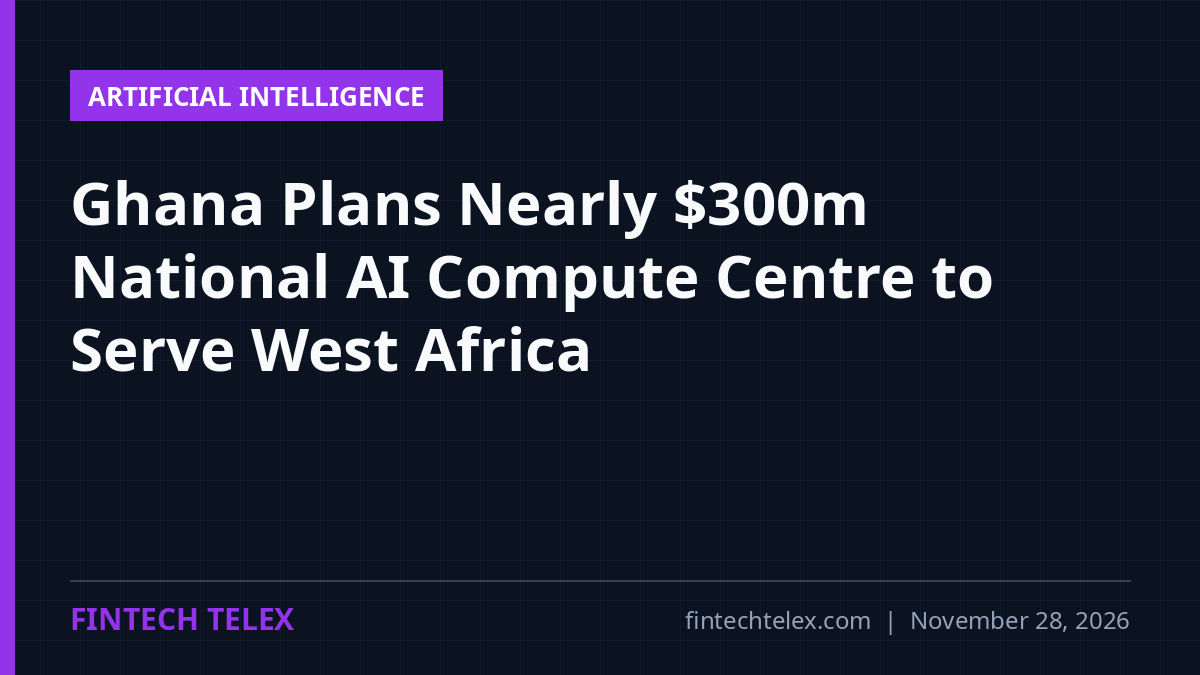
ACCRA — Ghana plans to invest close to US$300 million in its own artificial intelligence computing infrastructure, with a national centre meant to serve researchers and companies across West Africa, the country’s communications minister has said.
Samuel Nartey George, Minister for Communication, Digital Technology and Innovations, announced the plan on Thursday, 26 November, at the 8th Privacy Symposium Africa in Accra, organised by Unwanted Witness with support from the Media Foundation for West Africa, The Herald Ghana reported.
“We’re investing close to $300 million to build our own compute infrastructure, not just for Ghana but for our sub-region,” he said, according to Modern Ghana.
What the money is for
The investment sits under Pillar Eight of Ghana’s 2027 budget, which sets out plans to establish a National Artificial Intelligence Centre and to upgrade rural 2G networks to 4G between 2027 and 2028, Modern Ghana reported. The budget links the rural upgrade to farmers’ access to weather and market information, digital payments and buyers.
The government has not published a breakdown of how much of the roughly US$300 million goes to the compute centre and how much to rural connectivity, or who will build and operate the facility.
“He who owns the infrastructure”
Speaking on the symposium’s theme, “Money, Data, Control,” George argued that renting computing power from foreign providers is not the same as owning it. “Buying computing services from the world and co-owning their infrastructure that produces them are two different things,” he said. “He who owns the infrastructure is really the one in control.”
He also outlined other measures under Ghana’s 10-year National Artificial Intelligence Strategy, including plans to train one million people in digital skills and a National Data Exchange Hub that would connect 48 government data registries that now run separately. Public-sector AI purchases will go through a central technical review covering interoperability, data protection, cybersecurity, sustainability and local skills transfer, he said.
Separately, George has said Ghana’s 2012 data protection law will be reviewed.
Voices on rights and data
Dr Arnold Kavaarpuo, executive director of Ghana’s Data Protection Commission, said the growing value of data in the AI era raised questions about who benefits from it and who controls it. Mike Ssegawa, board chair of Unwanted Witness, warned that Africa’s digital shift “must not come at the expense of people’s rights, dignity and freedoms.”
What it means for African readers
Access to GPUs is one of the biggest costs for African AI start-ups, many of which rent capacity from data centres in Europe or the United States. A shared regional facility could lower that cost and keep sensitive data closer to home, if pricing and access rules are fair to small firms.
Ghana is not alone. Nigeria and Togo this week signed a deal on twin data parks, and South Africa’s president has backed a proposed R100 million AI start-up fund. The open question is whether these national projects will connect, or compete for the same investors and talent.
Fintech Telex will follow the procurement and timeline for Ghana’s AI centre.