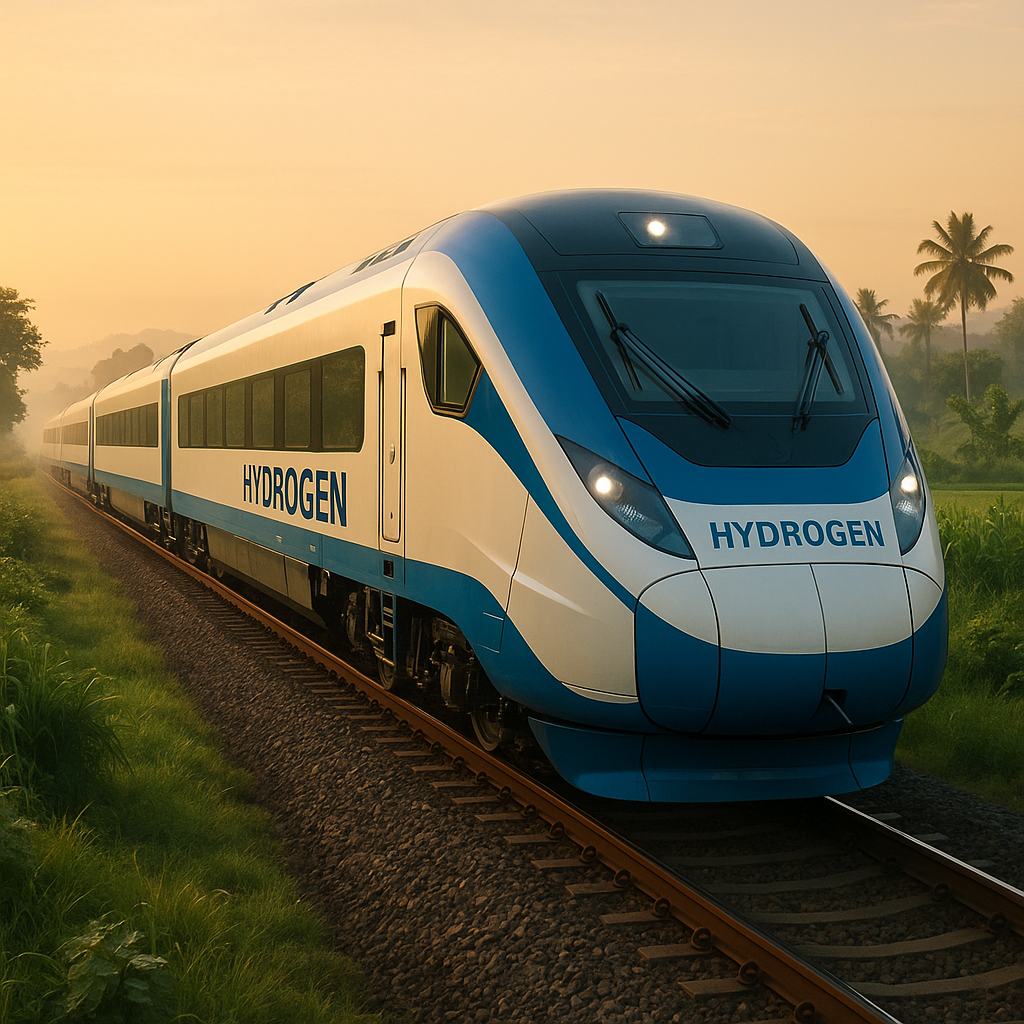
India is preparing to introduce its first indigenous hydrogen-powered train, marking a notable step in the country’s push toward cleaner transport. The train is expected to run on the Jind-Sonipat route, and railway officials have presented it as a futuristic, smoke-free and pollution-free option for passenger mobility. While the launch is significant in symbolic terms, it also reflects a wider shift in how major rail networks are thinking about energy, emissions and long-term operating costs.
For Indian Railways, one of the largest rail systems in the world, even a limited hydrogen rollout carries weight. Rail remains central to India’s economic and social life, connecting major cities, industrial corridors and smaller towns. Any attempt to reduce dependence on diesel in sections that are not fully electrified has the potential to influence both environmental policy and transport planning in the years ahead.
What is a hydrogen train and how does it work?
A hydrogen-powered train typically uses fuel cells to generate electricity. In simple terms, hydrogen stored on board is combined with oxygen in a fuel cell, producing electrical energy to power the train’s systems and traction motors. The main by-products are water and heat, which is why the technology is often described as a cleaner alternative to fossil-fuel-based transport.
Unlike conventional diesel trains, hydrogen trains do not rely on combustion engines in the same way. They are also different from fully electric trains that draw power from overhead lines or other fixed infrastructure. This makes hydrogen particularly relevant for routes where electrification is limited, expensive or still under development. In such cases, hydrogen can offer a way to cut emissions without waiting for full network upgrades.
Why the Jind-Sonipat route matters
The choice of the Jind-Sonipat route places the spotlight on a real-world corridor rather than a lab-scale demonstration. That matters because transport technologies often prove their value only when they operate under regular conditions, with everyday maintenance demands, scheduling pressures and passenger expectations. If the train performs reliably, it could strengthen the case for similar deployments on other non-electrified or partially electrified routes.
India has spent years modernising its railway network through electrification, station redevelopment, faster services and indigenous manufacturing. The arrival of a homegrown hydrogen train fits into that broader strategy. It is not merely about adopting a global trend; it is also about showing that advanced clean-transport solutions can be designed, adapted and operated within India’s own industrial and engineering ecosystem.
A broader global context
Hydrogen trains have already attracted attention internationally, especially in countries exploring alternatives to diesel on regional lines. Their appeal lies in offering lower-emission mobility without the full cost of installing electric infrastructure across every route. India’s entry into this space suggests that hydrogen is no longer a niche experiment limited to a few advanced markets. Instead, it is becoming part of a wider debate about the future of rail decarbonisation.
That said, the success of hydrogen rail depends on more than the train itself. It requires dependable hydrogen production, safe storage, refuelling systems and cost-effective operations. Much also depends on where the hydrogen comes from. If produced using cleaner energy sources, the environmental benefits are stronger. If produced through more carbon-intensive methods, the climate advantage becomes less clear. That is why hydrogen transport is often discussed alongside renewable energy and industrial policy.
Why this story matters
For readers, this development matters because rail technology shapes everyday life in visible and invisible ways. Cleaner trains can improve local air quality, reduce dependence on imported fossil fuels and support broader climate goals. For a country of India’s scale, small changes in transport energy choices can add up to large national effects over time.
The introduction of an indigenous hydrogen train also carries strategic significance. It signals ambition in an era when transport is increasingly linked to energy security, manufacturing capability and environmental credibility. Even if hydrogen does not replace every diesel train, its use on selected routes could become an important part of a mixed future that includes electrification, battery systems and other low-emission technologies.
In that sense, the Jind-Sonipat launch is more than a new train on a new route. It is an early test of whether India can turn clean-transport promise into practical, scalable reality on one of the world’s busiest railway networks.