


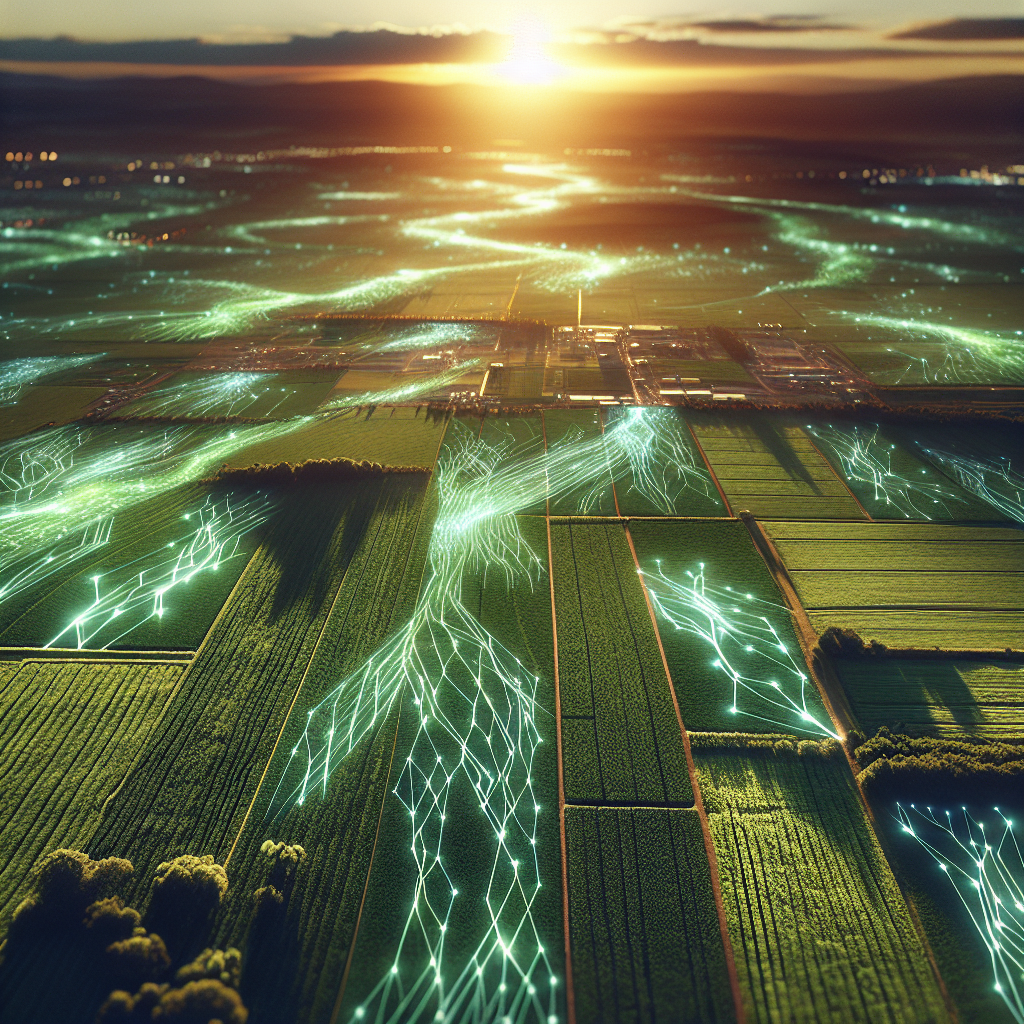
Palantir has signed a $300 million agreement with the U.S. Department of Agriculture, extending the software company’s reach further into civilian government work as officials look for better ways to manage farmland and protect food supply chains. The deal, as described in the source material, will see the USDA use Palantir’s technology amid rising geopolitical risks that have exposed how vulnerable global agricultural systems can be.
The agreement also reflects a broader shift for Palantir. Long associated with military, intelligence, and defense contracts, the company has spent recent years trying to prove that its data platforms can be just as valuable in sectors such as healthcare, manufacturing, energy, and government administration. A major USDA contract gives that effort new weight, placing Palantir inside one of the most strategically important parts of the U.S. economy: food production.
Why agriculture is becoming a data and security issue
Food supply has always depended on weather, land, labor, and transportation. What has changed is the degree to which those factors are now tied to global political instability, cyber risks, and real-time logistics. Wars, trade disputes, sanctions, shipping disruptions, and climate-driven events have all contributed in recent years to concerns about whether nations can move food efficiently and keep prices under control.
For the United States, farmland management is no longer just an agricultural question. It is increasingly treated as part of national resilience. The USDA oversees a vast set of responsibilities tied to farm programs, rural development, conservation, and food systems. Software that can integrate large volumes of information, identify patterns, and help officials respond faster may become more important as supply chains grow more complex and less predictable.
That is where Palantir’s model fits. The company is known for software designed to bring together fragmented datasets and turn them into operational tools for decision-making. In a farming context, that can mean helping agencies monitor land use, allocate resources, track risks, or coordinate responses across different offices and programs. While the exact operational scope of the USDA deal was not fully detailed in the source material, the broader logic is clear: governments want better visibility into systems that are essential to economic and social stability.
A long trend meets a new era of uncertainty
The use of advanced software in agriculture is not new. Precision farming, satellite imaging, predictive analytics, and digital mapping have been developing for years. What is new is the urgency. The pandemic revealed how quickly transportation bottlenecks and labor shortages could disrupt food systems. Russia’s war in Ukraine underscored the geopolitical importance of grain and fertilizer markets. At the same time, extreme weather has made production planning more difficult across many regions.
Against that backdrop, governments are investing more heavily in tools that can improve forecasting, coordination, and resilience. The USDA’s decision to expand its work with Palantir suggests that agricultural oversight is becoming more technology-intensive, and more closely linked to strategic planning. In practical terms, that could help officials make faster decisions when markets shift or when supply chain stress threatens farm operations and consumers alike.
Why this matters beyond Washington
For readers, the significance of this deal goes well beyond one company winning another federal contract. Food prices, supply reliability, and farm productivity affect households directly. If better data systems help government agencies respond more effectively to disruptions, the benefits could eventually be felt in everything from crop planning to grocery store stability. Even incremental improvements in how farmland and agricultural resources are managed can matter when inflation, climate stress, and global conflict are already pressuring consumers.
The agreement is also notable for what it says about the business landscape. Palantir’s expansion into agriculture highlights how companies once defined by defense work are finding new opportunities in civilian infrastructure and public administration. That convergence may become more common as governments seek technology partners capable of managing complex, mission-critical systems.
Still, such deals are likely to draw scrutiny. Whenever a private technology company takes on a larger role inside government, questions tend to follow about oversight, cost, transparency, and how data is handled. Those debates are likely to accompany Palantir’s growing footprint in non-military agencies as well.
For now, the USDA agreement signals a simple but important reality: food security is increasingly being treated as a strategic issue, and the software used to manage it is becoming as consequential as the physical infrastructure that moves food from farmland to market.