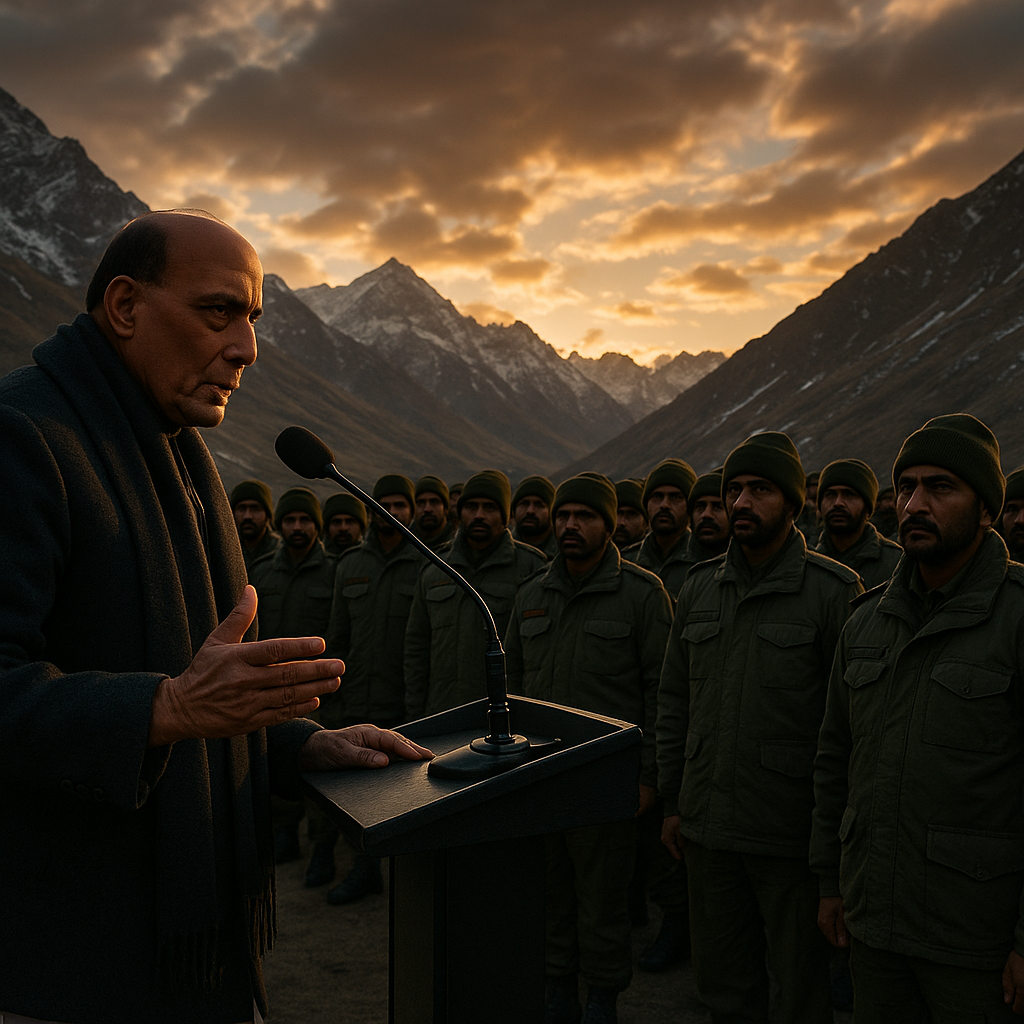
On the eve of Kargil Vijay Diwas, Defence Minister Rajnath Singh travelled to Dras, one of the most symbolically important locations linked to the 1999 Kargil conflict, and told Army personnel that the intent of infiltrators has not changed since that war. His message was both commemorative and cautionary: while India remembers the sacrifices that secured victory in Kargil, it must remain prepared for the same patterns of hostile intent that shaped the conflict more than two decades ago.
Addressing troops in the high-altitude region, Singh said the Indian Army is fully prepared to meet any future challenge. He also underlined the government’s focus on modernising the armed forces and equipping them with the latest technology, presenting readiness not merely as a matter of manpower and morale, but also as one of capability, systems and sustained defence investment.
Why Dras Still Carries Strategic Weight
Dras holds a special place in India’s military memory. Known as one of the key sectors of the Kargil War, it became a site of intense fighting during the 1999 conflict, when Indian forces launched difficult operations to recapture heights occupied by infiltrators and enemy-backed elements. The conflict remains one of the most defining military episodes in recent Indian history because of the terrain, the tactical surprise involved and the scale of sacrifice required to reverse the intrusion.
Kargil Vijay Diwas, observed every year, honours the soldiers who fought and died in that campaign. Singh’s visit to Dras therefore carried significance beyond a routine morale-building address. By linking present-day vigilance with the memory of Kargil, the government reinforced a long-standing national security message: the lessons of 1999 remain relevant in today’s strategic environment.
From Kargil to the Present
The Defence Minister’s remarks suggest continuity in India’s threat perception along sensitive borders and infiltration-prone areas. His statement that the intent of infiltrators remains unchanged indicates that, in the government’s view, the challenge is not an isolated historical event but a recurring security concern. In practical terms, that means surveillance, forward deployment, intelligence coordination and rapid response remain central to military preparedness.
Over the years, India has increasingly stressed border infrastructure, better logistics in extreme terrain, and the induction of advanced weapons, communications systems and surveillance tools. Singh’s emphasis on modernisation fits into this broader policy direction. The message to troops is that preparedness must evolve with technology, while the message to adversaries is that India intends to close the kinds of gaps that made infiltration attempts dangerous in the past.
Why the Statement Matters
For readers, the significance of Singh’s remarks lies in the intersection of memory, security and policy. Kargil is not remembered only as a victory; it is also studied as a warning about the cost of complacency. When a defence minister says hostile intent has not changed, he is signalling that anniversaries are not just ceremonial occasions. They are moments to assess whether the country is ready for future contingencies.
Locally, such statements resonate strongly in regions connected to military deployment and border security, where communities live with the realities of strategic tension. Nationally, they reinforce the government’s effort to project confidence in the armed forces and reassure the public that preparedness remains a priority. For military families and veterans, the remarks also connect present-day policy with the legacy of those who served in Kargil.
Broader Regional and Global Context
In a wider sense, Singh’s comments come at a time when border management, military modernisation and strategic signalling are central concerns across many regions of the world. Mountain warfare, surveillance technology and rapid mobilisation have become increasingly important in modern conflict environments. India’s emphasis on readiness reflects not only its own security calculations but also a broader global pattern in which nations are investing heavily in deterrence and resilience.
Singh also expressed confidence that the Indian armed forces would become the best in the world. While such declarations are aspirational, they point to a clear policy ambition: combining operational experience with technological advancement to create a more agile and capable military. In Dras, on the eve of a solemn national commemoration, that aspiration was framed against the hard lessons of history — and the enduring belief that vigilance remains the first line of defence.