

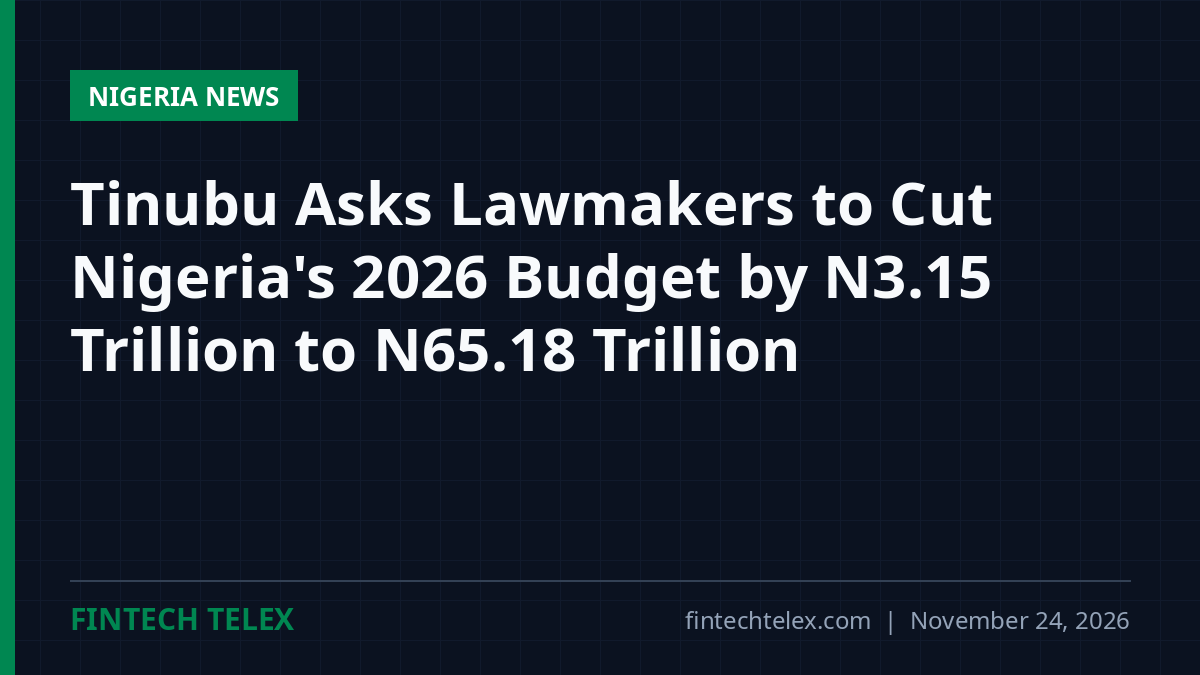
ABUJA — President Bola Tinubu has asked the National Assembly to cut Nigeria’s 2026 budget by about N3.15 trillion, in a bill to repeal and re-enact the Appropriation Act passed earlier this year.
His letter was read on Tuesday by the Speaker of the House of Representatives, Tajudeen Abbas, Daily Post reported. In the Senate, President of the Senate Godswill Akpabio read a matching letter and referred it to the Committee on Rules and Business, Channels Television reported.
The revised numbers
Under the revised 2026 Federal Government Fiscal Framework sent to lawmakers:
- total spending: N65.176 trillion, down from N68.323 trillion approved by the National Assembly
- federal revenue, including government-owned enterprises: N33.720 trillion
- capital spending: N26.232 trillion
- deficit: unchanged at N31.457 trillion, or 5.64% of GDP
- new borrowing: unchanged at N29.218 trillion, made up of N18.428 trillion domestic and N10.790 trillion external
Tinubu also said a proposed $7.7 billion external loan, estimated at N10.368 trillion, would finance an existing foreign borrowing provision and would not raise the overall borrowing limit, Channels reported.
Why the change
In the letter, the president said the adjustments were needed to align the budget with existing obligations and available resources. Channels said he also described them as a way to prioritise existing commitments, strengthen the credibility of the budget and improve capital budget implementation while maintaining fiscal discipline. He urged lawmakers to pass the bill quickly so the revised budget can be implemented and outstanding obligations settled.
The bill now awaits consideration by both chambers. It comes as the president is expected to present the 2027 budget before the end of December.
How the budget grew, and now shrinks
Tinubu first presented a N58.18 trillion budget for 2026 in December 2025. Lawmakers approved a larger budget of N68.323 trillion in March. The new proposal brings total spending back down by about 4.6%.
The deficit and borrowing figures have not moved. That means the cut is in planned spending rather than in the amount the government expects to borrow.
What it means for Nigerians
With only five weeks left in the year, the revision is largely about matching the budget to what the government can actually pay for, including bills already owed to contractors. For businesses and households, the bigger signals are the unchanged N29.2 trillion borrowing plan and the 5.64% deficit, which keep pressure on interest rates and the cost of credit.
Lawmakers’ scrutiny of the revised framework, and of the 2027 budget due next month, will show how the government plans to bring borrowing down.
Key questions for the committees include which projects lose funding under the N3.15 trillion cut, how much of the capital budget has actually been released this year, and whether the revenue projection of N33.72 trillion is realistic given collections so far. Civil society groups that track budget implementation are likely to press for those details during the review.
Nigerians can follow the bill’s progress through the published order papers of both chambers, and the revised figures will matter for anyone owed money by the federal government, from contractors to state governments awaiting transfers.