
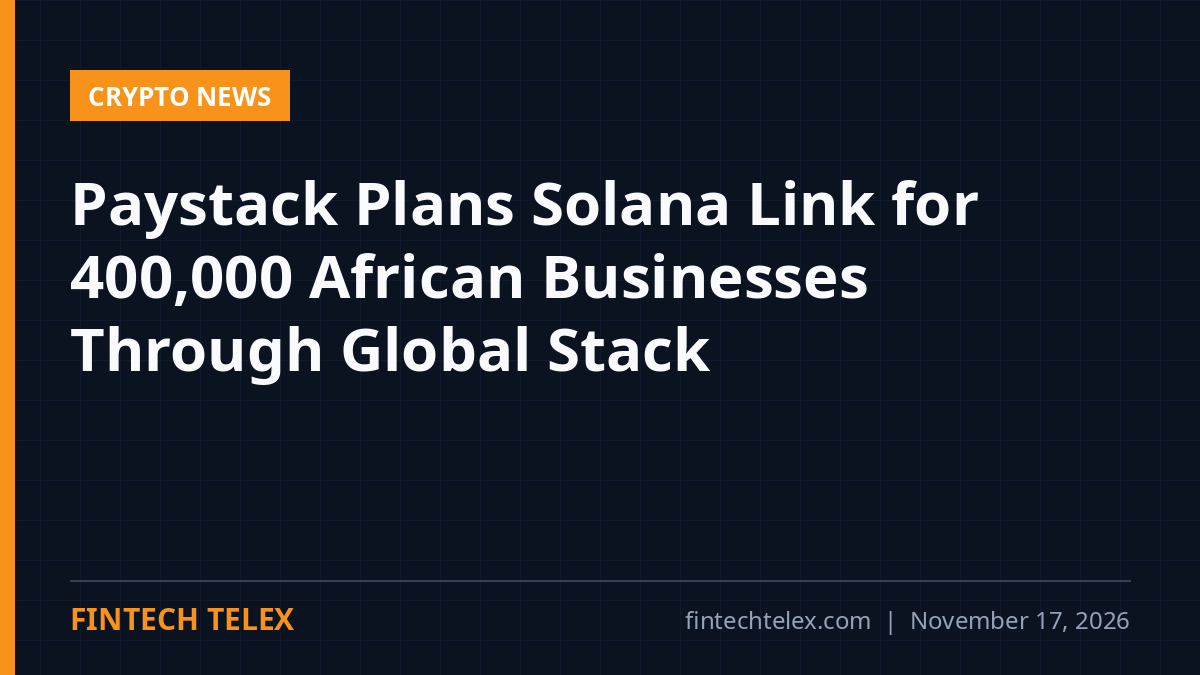
LONDON — Paystack, the Nigerian-founded payments company owned by Stripe, plans to connect its African payment network to the Solana blockchain, chief executive Shola Akinlade told the Solana Breakpoint 2026 conference in London on Monday, November 16.
Akinlade said more than 400,000 businesses across Africa use Paystack, collectively processing over $15 billion in payments a year, Technext reported. The company also holds 11 licences in seven markets, works with more than 50 banks and payment partners, and runs a risk system that handles over 60 million transactions a month. The $15 billion figure is total payment volume, not revenue.
What Global Stack does
The plan centres on Global Stack, a single API that connects the ways Africans already pay, including bank transfers, mobile money such as M-Pesa, and cards, to the onchain economy, Condia reported. Paystack aims to offer on-ramps and off-ramps that let businesses move value onto and off Solana using local payment rails.
A product site for Global Stack describes four steps: collect by bank transfer or mobile money, hold the balance in stablecoins such as USDC, convert back to local currency, and pay out in 20 African markets, Solana Compass reported. It lists Solana, Base and Ethereum as supported networks and offers named virtual accounts in Nigeria, South Africa, Ghana and Kenya. Access runs through a waitlist.
Akinlade’s talk was titled “Bringing Africa’s 41 Currencies Onchain.” Paystack has not announced a go-live date for the Solana connection, Techpoint Africa noted.
Regulation is catching up
The announcement comes as African regulators formalise rules for stablecoins. The Central Bank of Nigeria’s new virtual asset regulations, effective November 5, require full reserve backing for stablecoins, set capital floors of ₦10 billion to ₦15 billion for issuers and ban algorithmic tokens, Technext reported. Condia said Paystack is taking part in the CBN’s supervisory pilot for virtual asset service providers, which it noted is not a licence.
Paystack moved under a new parent, The Stack Group, in January. At the time it said it holds a microfinance bank licence in Nigeria and was finalising a stablecoin licence in a key market, Solana Compass reported.
Paystack is not alone in building local-currency rails. At the Africa Stablecoin Summit in Cape Town this month, Supercoin, issuer of the rand-backed ZARsc stablecoin, launched borrowing against crypto on the VALR exchange and said it plans a Kenyan shilling stablecoin, KESsc, in 2027, subject to Central Bank of Kenya approval, Lifestyle and Tech reported. On the same Breakpoint day, US payments network Zelle picked Solana for its ZelleUSD stablecoin, according to Solana Compass.
Why it matters
Stablecoins are already widely used in Nigeria, Kenya and South Africa for savings and cross-border transfers. A processor of Paystack’s size building a regulated bridge between local currencies and dollar stablecoins could cut costs for freelancers, payroll platforms and exporters who today rely on slow correspondent banking. The key questions are timing, which merchants get access first, and how regulators in each market treat the stablecoin leg.
This article is for information only and is not investment advice.