


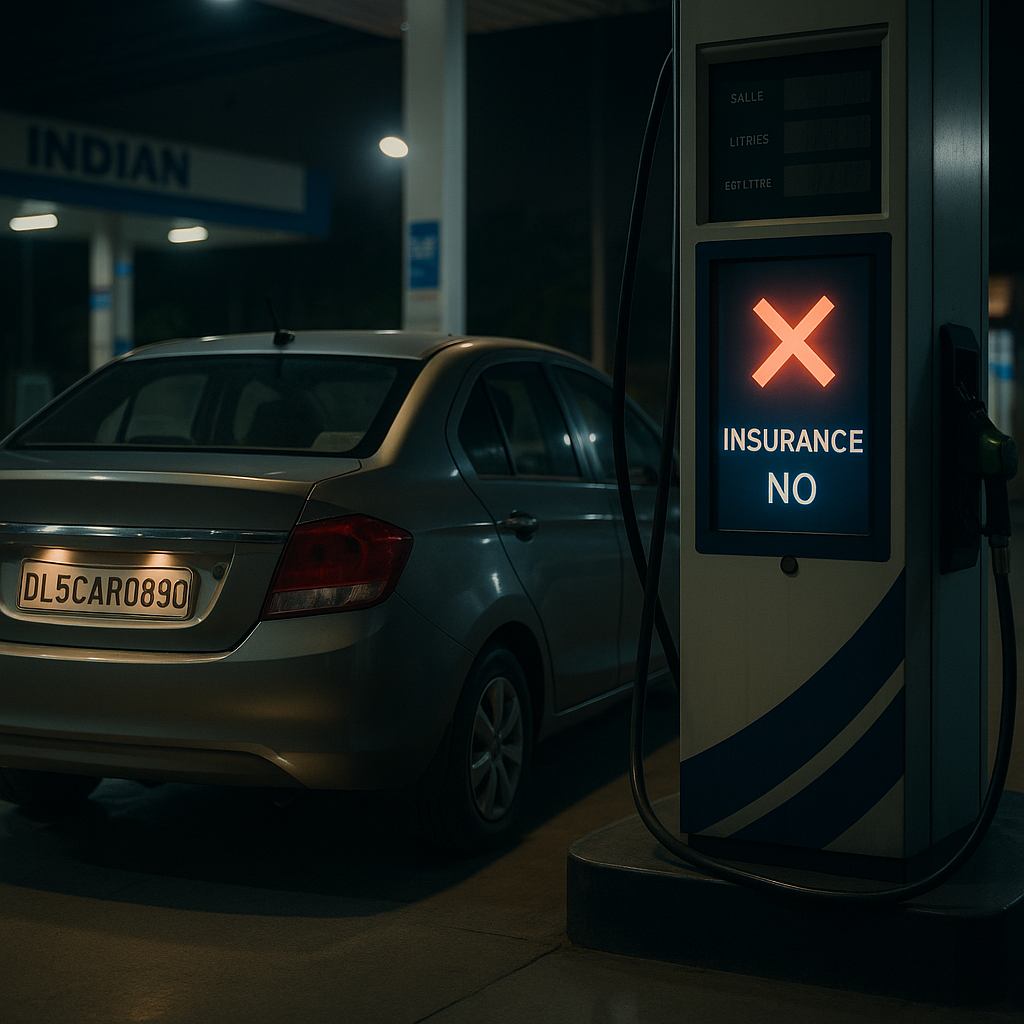
In a major intervention aimed at improving road safety and enforcing motor insurance rules, the Supreme Court has asked the Centre and the Insurance Regulatory and Development Authority of India (IRDAI) to work out a pilot project built around a simple idea: vehicles without valid insurance should not be able to buy fuel. The court also flagged the scale of the problem, noting that 16.54 crore vehicles in India are uninsured, a number that underlines the gap between the law on paper and compliance on the ground.
The proposed system is expected to use Automatic Number Plate Recognition, or ANPR, technology to identify vehicles and link them with insurance records. In addition, the mandatory insurance period for new vehicles has been extended by one year, a step intended to improve coverage at the point of purchase and reduce the chances of early lapses. Together, the measures signal a more technology-driven and stricter enforcement approach to a long-running policy challenge.
Why Motor Insurance Compliance Has Become a Major Concern
Third-party motor insurance is not optional in India; it is a legal requirement meant to ensure that accident victims can receive financial compensation. Yet compliance has remained uneven for years. Many vehicle owners renew registration-related documents and continue to use public roads, but fail to renew insurance on time. The result is a large pool of vehicles operating without the financial safeguards required under law.
This matters not only to insurers or regulators but to ordinary road users. When an uninsured vehicle is involved in a crash, victims can face long legal and financial uncertainty. The burden may fall on families, public institutions, or compensation mechanisms that are already under strain. At a time when India continues to grapple with a high volume of road accidents, enforcing basic insurance coverage is increasingly being seen as a public safety issue, not merely a compliance matter.
How the Proposed Pilot Could Work
The idea behind the pilot is straightforward: if a vehicle does not have active insurance, it should be prevented from refuelling. ANPR cameras can read a vehicle’s registration plate, match it against central databases, and determine whether the required insurance is in place. In theory, this creates a real-time compliance check at fuel stations and could become one of the most effective ways to identify uninsured vehicles in daily use.
Such a model would also mark a shift from episodic enforcement by traffic police to continuous, system-based monitoring. Instead of relying solely on random checks or post-accident verification, authorities would be building compliance into a routine activity that nearly every vehicle owner must undertake. That is what makes the proposal both ambitious and potentially far-reaching.
Background: From Manual Checks to Digital Enforcement
India’s motor vehicle ecosystem has been moving gradually toward digital verification for years, with databases for registration, licences, and insurance becoming more integrated. Courts and regulators have repeatedly expressed concern over weak enforcement, especially in relation to uninsured vehicles and delayed compensation. The latest push reflects a broader trend in governance: using digital infrastructure to close compliance gaps that older manual systems could not effectively address.
Globally, governments have used technology in different ways to monitor transport compliance, whether through toll systems, emissions checks, or registration databases. India’s proposed fuel-linked enforcement stands out because it ties legal compliance directly to vehicle usability. If implemented carefully, it could become a model for other regulatory areas where violations are widespread but difficult to police through conventional methods.
What It Could Mean for Vehicle Owners and the Industry
For consumers, the immediate message is clear: insurance can no longer be treated as a document to be renewed only when convenient. If the pilot succeeds, lapses could lead to instant practical consequences. For insurers, the move may expand coverage and improve renewal rates, though it may also require better data coordination and faster grievance redressal in case of errors. For fuel retailers and enforcement agencies, the challenge will be execution, especially ensuring that database mismatches, technical glitches, or outdated records do not unfairly affect motorists.
The story matters because it sits at the intersection of law, technology, and everyday life. Millions of Indians rely on vehicles for work, family, and mobility, and any reform that connects road access to real-time regulatory compliance will have broad consequences. The Supreme Court’s push suggests that the era of lightly enforced insurance rules may be nearing its end. What comes next will depend on how effectively the pilot is designed, how reliably the technology works, and whether the system can balance strict enforcement with fairness and accuracy.