


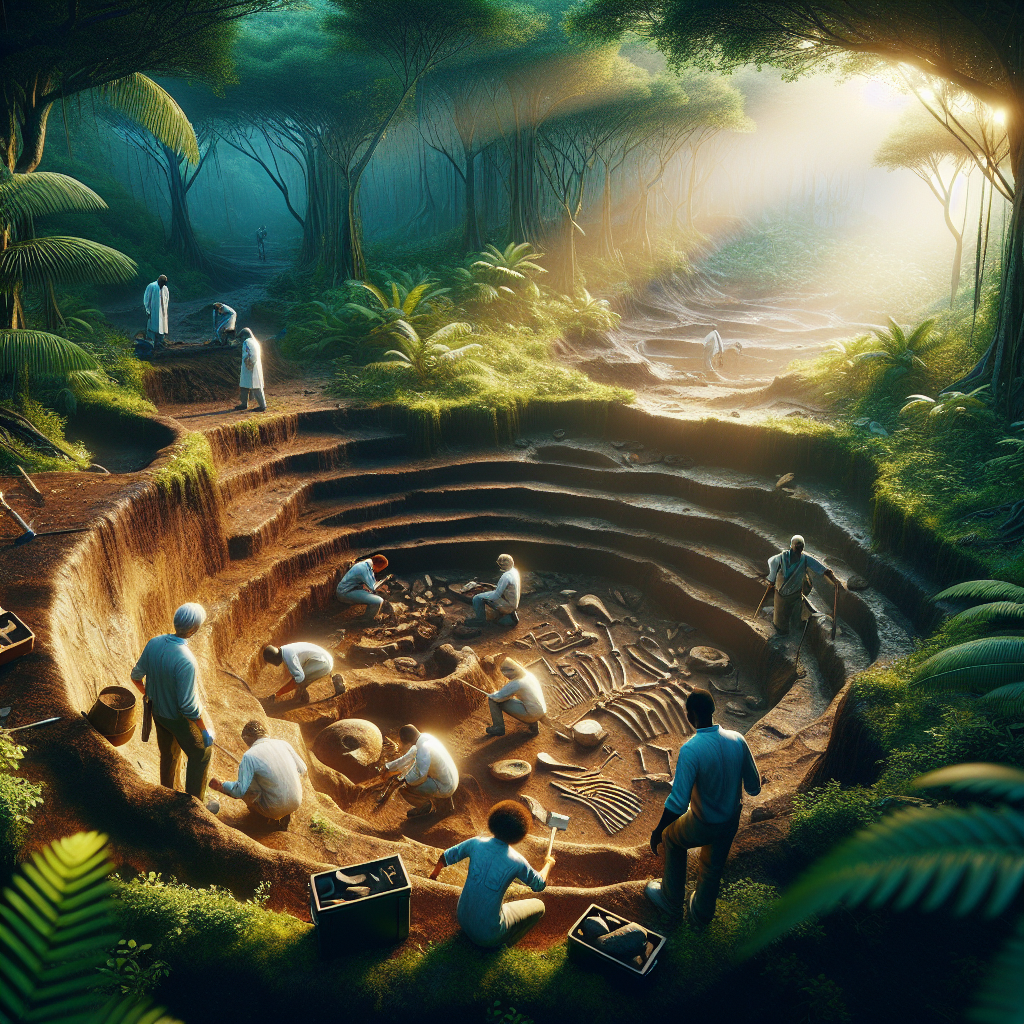
A monumental archaeological excavation in Africa has opened an extraordinary window into the lives of humans who roamed the continent 100,000 years ago. This groundbreaking discovery, detailed through an extensive collection of artifacts and remains, promises to significantly deepen our understanding of early Homo sapiens, their daily existence, and their relationship with the ancient landscapes they inhabited.
The site, whose exact location is strategically important within the broader narrative of human origins in Africa, has yielded a wealth of evidence. Thousands of meticulously preserved stone artifacts, alongside vertebrate remains and sedimentary layers, paint a vivid picture of sustained human activity. Researchers believe these finds strongly suggest repeated visits by our ancestors to a specific locale, indicating not just transient presence but a more habitual engagement with their environment. The nature of these artifacts—tools crafted for various purposes—points towards sophisticated cognitive abilities and adaptive behaviors that were crucial for survival in the prehistoric world.
Rewriting Chapters of Human History
This discovery arrives at a pivotal time, adding critical detail to the complex tapestry of human evolution. Around 100,000 years ago, Africa was the epicenter of profound developments for our species. While anatomically modern humans had emerged much earlier, this period saw the refinement of tool technologies and the potential beginnings of more complex social structures that would eventually pave the way for migrations out of Africa. These new findings offer tangible proof of how Homo sapiens interacted with their surroundings during what is broadly known as the Middle Stone Age—a period characterized by innovative tool-making techniques, including the development of projectile points and blades, which marked a significant departure from earlier, more rudimentary technologies.
The detailed analysis of sediments also provides invaluable insights into the ancient ecosystem. The evidence strongly suggests repeated visits by Homo sapiens in a wooded environment. This particular detail is crucial, as it contributes to our understanding of early human adaptability. While many archaeological sites from this era might point to savannah or coastal settings, a significant presence in a wooded area highlights the versatility of our ancestors in exploiting diverse ecological niches for resources, shelter, and sustenance. Understanding the specific environmental context allows scientists to reconstruct the challenges and opportunities faced by these ancient communities, offering a glimpse into their daily struggles and triumphs.
Global Resonance of an Ancient Discovery
The implications of this excavation extend far beyond its immediate geographical confines. Globally, this discovery reinforces Africa’s undisputed role as the cradle of humanity. By providing concrete evidence of early human behavior and adaptation 100 millennia ago, it helps to refine the timeline and routes of eventual human dispersal across the globe. Each new piece of the puzzle from Africa aids in tracing the lineage of every human alive today, underscoring our shared ancestry and the incredible journey our species has undertaken from its earliest origins.
For the average reader, stories like this resonate deeply because they speak to fundamental questions about who we are and where we come from. This isn’t just about ancient bones and stones; it’s about connecting with the very earliest chapters of the human story. It’s about recognizing the ingenuity, resilience, and adaptability that defined our ancestors and, in many ways, continue to define us. These discoveries remind us that our past is a dynamic, evolving narrative, constantly being enriched by the tireless work of archaeologists who dedicate their lives to unearthing the secrets buried beneath our feet. Such findings are a testament to the enduring human spirit and our innate drive to understand our place in the vast sweep of time.