

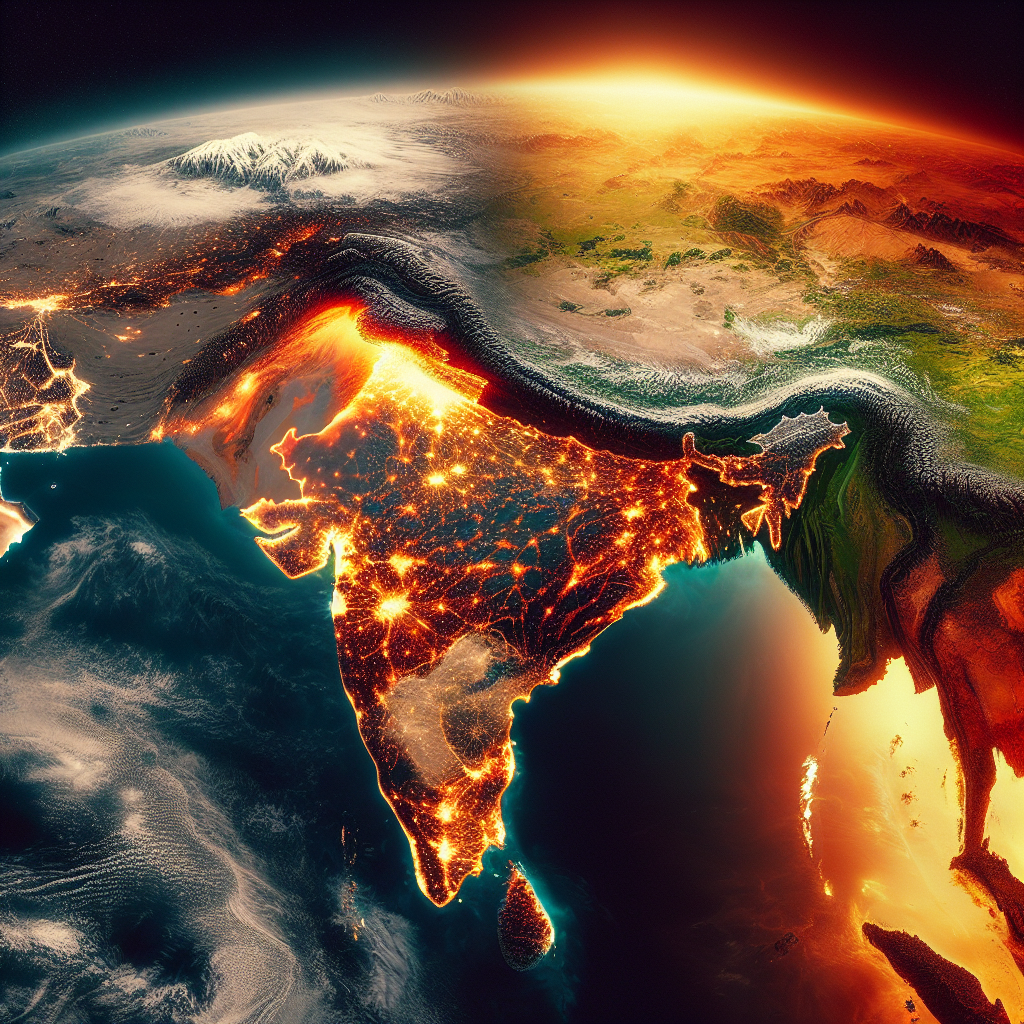
A weather map shared widely on social media has triggered a familiar but important argument: how could India appear hotter than large parts of Africa, a continent many people instinctively associate with extreme heat? The image, amplified by the account Indian Tech & Infra, quickly moved beyond a simple temperature graphic and became a broader discussion about climate, geography, urban growth, deforestation and the protective role of the Himalayas.
The debate reflects how easily weather visuals can reshape public understanding, even when they capture only a moment in time. A single heat map does not prove that one region is always hotter than another. Temperatures vary sharply by season, altitude, humidity, wind patterns, land cover and whether the map is displaying current conditions, averages or anomalies. Still, the viral reaction revealed a genuine public curiosity about why India can experience punishing heat while some parts of Africa may appear cooler on a given day.
Why the Comparison Took Off Online
At first glance, the comparison seems counterintuitive. Africa is vast and climatically diverse, containing deserts, tropical forests, highlands and coastal zones. India, though far smaller, also has remarkable geographic variety, from the Himalayas in the north to arid regions in the west, humid coasts in the south and densely populated plains in between. When a map compresses all that complexity into a few colors, it invites sweeping conclusions.
That is one reason the image spread so fast. It touched on several anxieties at once: climate change, disappearing tree cover, rapid construction, heat-trapping cities and the fear that South Asia is becoming increasingly difficult to live in during peak summer. Online users also pointed to the Himalayas, whose presence profoundly shapes the subcontinent’s climate by influencing winds, rainfall patterns and the movement of air masses.
Geography, Not Just Development, Shapes Heat
India’s intense pre-monsoon heat is not a new phenomenon. Long before modern urbanization, large parts of the Indo-Gangetic plain and central India regularly experienced severe hot spells. Seasonal heating over land, dry conditions in some regions and delayed monsoon relief can push temperatures sharply higher. By contrast, many parts of Africa are moderated by elevation, cloud cover, surrounding ocean systems or seasonal rainfall. East African highlands, central equatorial zones and southern coastal areas do not behave like the Sahara, even if popular imagination often treats Africa as one uniform climate zone.
That said, development can worsen local heat. Expanding concrete surfaces, fewer trees, vehicle emissions and dense construction all contribute to the urban heat island effect, in which cities retain more warmth than surrounding areas. In India’s rapidly growing metropolitan areas, this effect can turn already difficult hot weather into a public health hazard.
Why Deforestation Entered the Discussion
Deforestation became a major theme in the online reaction because vegetation plays a visible and practical role in regulating local temperature. Trees provide shade, cool the air through evapotranspiration and help reduce the heat absorbed by buildings and roads. When green cover is replaced with paved surfaces, heat often becomes more intense and more persistent. While no single viral map can quantify that impact, the connection is widely understood enough that people immediately linked the image to concerns about land use and environmental planning.
This is also why the story matters beyond social media. Extreme heat is not just an abstract climate issue. It affects farm work, water demand, power consumption, school routines, outdoor labor and public health, especially for poorer households with limited access to cooling. In both India and Africa, heat is experienced unevenly. The worst effects are usually felt by those who have the least protection from them.
What Readers Should Take From the Viral Map
The most useful lesson is not whether India is categorically hotter than Africa. It is that climate comparisons require context. Continents are not single-temperature entities, and weather maps are snapshots, not verdicts. But the intensity of the reaction shows how heat has become a deeply political and personal issue, tied to how people think about development, environmental loss and resilience.
For readers, the viral map is a reminder that geography still matters, but so do human choices. Mountain barriers, seasonal winds and regional landscapes shape climate in powerful ways. Yet urban design, tree cover and land management can make that climate more bearable or more brutal. In that sense, the debate was about far more than a colorful map. It was about how societies understand rising heat — and what they are willing to do about it.