

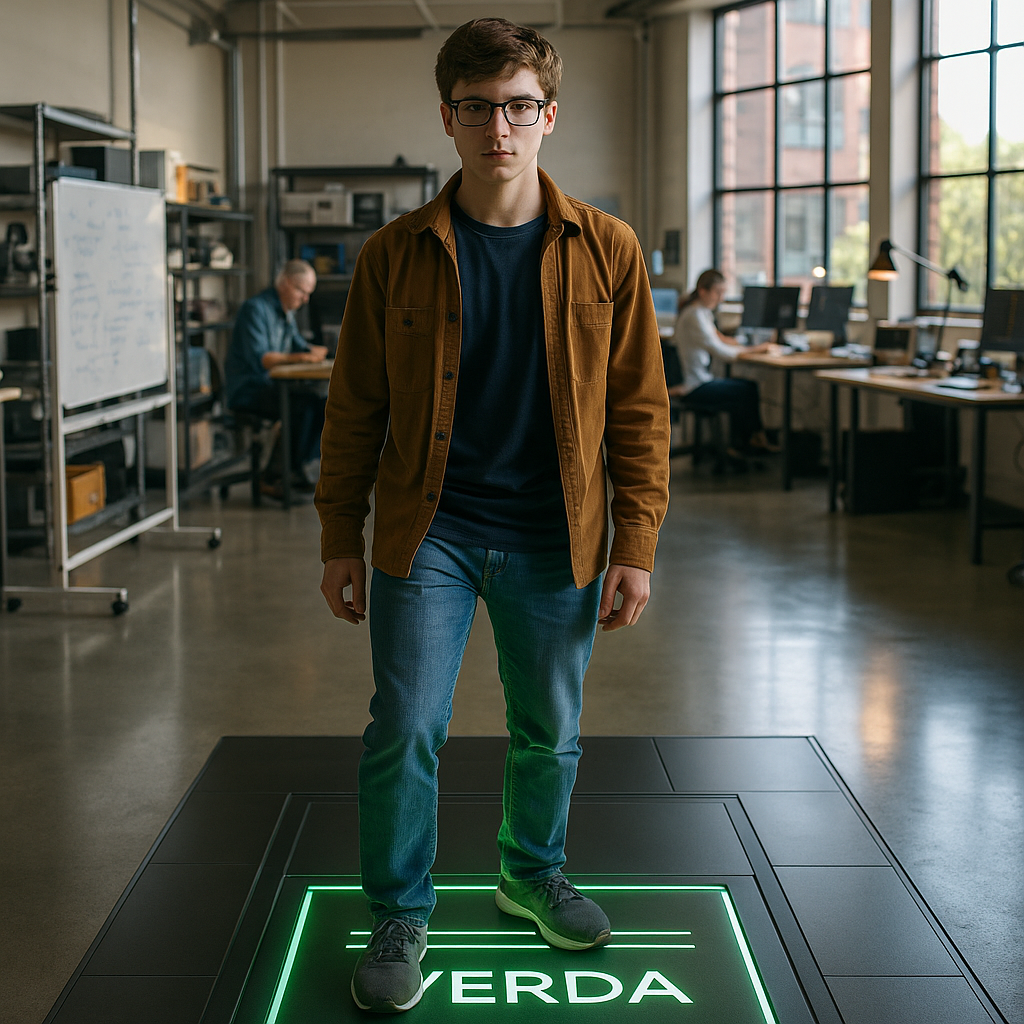
A Massachusetts student is drawing national attention for an idea that sounds futuristic but is rooted in a practical everyday reality: people are always moving, and that movement carries energy. His invention, called VERDA, is designed to capture power from footsteps and other forms of motion and convert it into usable electricity. The project has now helped make him a finalist in the 2026 3M Young Scientist Challenge, a competition known for highlighting student-led innovations with real-world potential.
At its core, VERDA is an energy-harvesting system aimed at cleaner power generation. Rather than relying solely on large-scale infrastructure, the concept looks to a resource that is constantly being produced and often wasted: kinetic energy from ordinary human activity. Walking across a floor, shifting body weight, or creating other small movements may seem insignificant on their own, but technologies in this field attempt to gather those tiny bursts of energy and turn them into something useful.
A Long-Standing Scientific Idea With New Relevance
The broader idea behind VERDA is not entirely new. Scientists and engineers have long explored ways to convert mechanical motion into electrical energy. Piezoelectric materials, for example, can generate small electric charges when compressed or bent, and researchers have tested such systems in shoes, sidewalks, train stations, and even roadways. The challenge has usually been efficiency, cost, and scalability: how to capture enough power to make the technology practical in everyday settings.
What makes projects like VERDA especially timely is the larger global push toward cleaner and more decentralized energy systems. In recent years, the conversation around sustainability has expanded beyond solar panels and wind turbines to include energy efficiency, battery storage, and micro-generation technologies. In that landscape, harvesting power from motion fits into a growing interest in using overlooked energy sources to reduce waste and support low-power devices.
Why This Student Innovation Stands Out
Student science competitions often reward creativity, but the most memorable projects are usually those that connect invention with a recognizable public need. That appears to be the case here. VERDA is not framed simply as a classroom experiment. It is an attempt to address environmental concerns by rethinking how energy can be collected in ordinary spaces. The fact that the young inventor will now work with a scientist as part of the 3M Young Scientist Challenge underscores that the concept has moved beyond a rough idea and into a stage of further development.
That matters because many useful technologies begin in exactly this way: as focused prototypes designed to solve a narrow problem before being adapted for broader use. If systems like VERDA can be improved, they could someday contribute to powering sensors, lighting, or small electronics in schools, public buildings, transportation hubs, or other high-traffic environments. Even when such systems do not replace major power sources, they can help supplement them and reduce energy waste.
Potential Impact at the Local and Global Level
Locally, an invention like this resonates in schools and communities that are increasingly encouraging students to think about climate solutions not as abstract political debates but as engineering challenges. A project built around harvesting motion can also serve as an educational tool, showing how physics, environmental science, and design can come together in a tangible way.
Globally, the implications are broader. Many parts of the world are looking for resilient, low-cost ways to support small-scale electrification and smart infrastructure. Technologies that produce modest amounts of electricity from everyday activity could become useful in places where efficiency and self-sustaining systems matter most. They may not solve the world’s energy challenges alone, but they could play a role in a larger ecosystem of clean-energy innovation.
Why This Story Matters
There is also a human reason this story stands out. It is about more than one competition finalist or one promising device. It is a reminder that innovation often comes from curiosity paired with purpose. The student behind VERDA has said he hopes to become an inventor focused on environmental protection technologies, and that ambition reflects a larger generational shift. Younger innovators are increasingly approaching science not just as discovery, but as a tool for solving urgent public problems.
For readers, that makes this more than a feel-good profile. It is a glimpse of how the next wave of climate and energy solutions may emerge: from classrooms, from local communities, and from young people asking whether the energy we overlook every day could be put to better use.